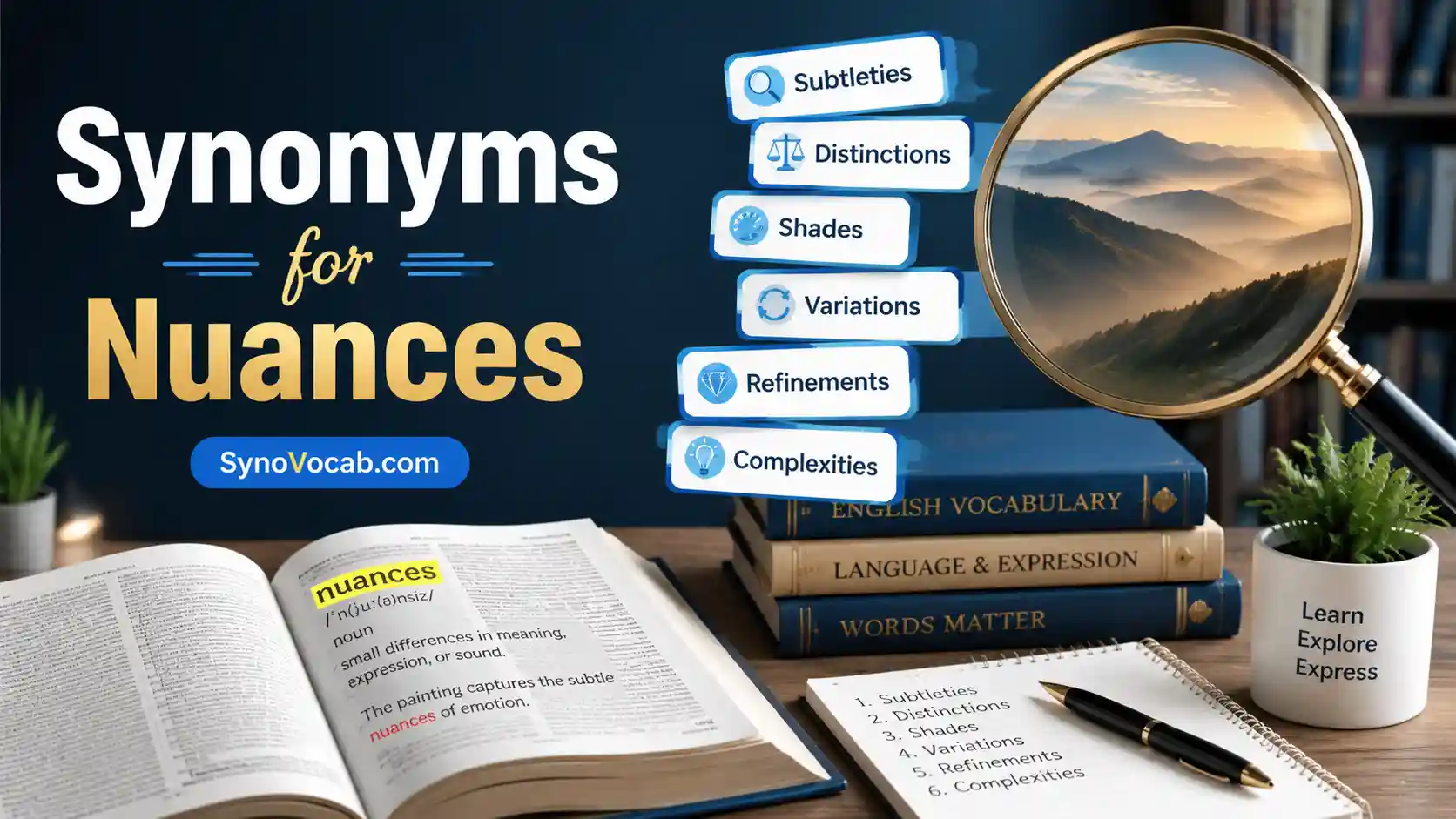
Quick answer: Synonyms for nuances include subtleties, distinctions, variations, shades, details, refinements, and differences.
The word “nuances” helps us describe the small differences that make ideas, feelings, or situations more meaningful. A simple example is noticing the nuance between “confident” and “arrogant.”
Nuances refer to slight variations, delicate details, or small distinctions that are not always obvious at first. Understanding them helps people express ideas with greater accuracy.
Learning alternatives for nuances improves vocabulary for students, writers, bloggers, and English learners. It helps communication become clearer, more precise, and more engaging.
Strong word choices allow speakers and writers to describe complex thoughts without repeating the same terms. Using the right alternative can add depth to essays, articles, emails, and conversations.
What Does Nuances Mean?
The word nuances means small differences, subtle details, or slight variations in meaning, appearance, behavior, or feeling. It is usually used when something has layers that require careful observation.
Nuances are often connected with things that are not immediately noticeable. They help explain why two similar ideas, emotions, or situations may still feel different.
Examples:
- The writer captured the emotional nuances of the character.
- Good communication requires understanding cultural nuances.
- The painting contains many subtle nuances of color.
Best Synonyms for Nuances
Different alternatives for nuances work better in different situations. Some words describe tiny differences, while others focus on details, complexity, or variations.
1. Subtleties
Meaning: Small details or differences that are difficult to notice.
Example: She understood the subtleties of the conversation.
2. Distinctions
Meaning: Clear differences between similar things.
Example: The teacher explained the distinctions between the two theories.
3. Variations
Meaning: Small changes or differences in something.
Example: The recipe has several regional variations.
4. Shades
Meaning: Slight differences in meaning, feeling, or quality.
Example: The speech contained different shades of emotion.
5. Details
Meaning: Small pieces of information or features.
Example: The artist focused on every detail.
6. Refinements
Meaning: Small improvements or adjustments.
Example: The design needs a few refinements.
7. Differences
Meaning: Ways in which things are not the same.
Example: They noticed differences in their opinions.
8. Complexities
Meaning: Complicated parts or layers of something.
Example: The book explores human complexities.
9. Delicacies
Meaning: Fine or sensitive details requiring care.
Example: The musician understood the delicacies of the performance.
10. Fine Points
Meaning: Small but important details.
Example: She explained the fine points of the agreement.
11. Particulars
Meaning: Specific details about something.
Example: He studied the particulars of the case.
12. Features
Meaning: Noticeable qualities or characteristics.
Example: The software has useful features.
13. Characteristics
Meaning: Qualities that describe something.
Example: Honesty is one of his best characteristics.
14. Qualities
Meaning: Features or traits of something.
Example: The painting has unique qualities.
15. Elements
Meaning: Individual parts that form something.
Example: The story contains emotional elements.
16. Aspects
Meaning: Different parts or sides of an idea.
Example: We discussed all aspects of the problem.
17. Layers
Meaning: Different levels of meaning or complexity.
Example: The novel has many emotional layers.
18. Dimensions
Meaning: Different perspectives or parts of a subject.
Example: The issue has several dimensions.
19. Facets
Meaning: Different sides or parts of something.
Example: The documentary shows many facets of history.
20. Components
Meaning: Individual parts of a whole.
Example: Trust is a key component of friendship.
21. Differences in Detail
Meaning: Small changes between similar things.
Example: The expert noticed differences in detail.
22. Gradations
Meaning: Small stages or levels between extremes.
Example: The colors showed gradual gradations.
23. Degrees
Meaning: Levels of intensity or amount.
Example: People experience different degrees of stress.
24. Levels
Meaning: Different amounts or stages.
Example: The course covers several levels of difficulty.
25. Tones
Meaning: Particular feelings or qualities expressed.
Example: The message had a friendly tone.
26. Moods
Meaning: Emotional qualities or feelings.
Example: The music creates different moods.
27. Impressions
Meaning: Feelings or effects created by something.
Example: First impressions can influence opinions.
28. Interpretations
Meaning: Different ways of understanding something.
Example: The poem allows many interpretations.
29. Meanings
Meaning: Ideas or messages expressed by something.
Example: Words can have multiple meanings.
30. Implications
Meaning: Hidden meanings or possible effects.
Example: The decision has serious implications.
31. Suggestions
Meaning: Indirect ideas or hints.
Example: His words contained suggestions of doubt.
32. Hints
Meaning: Small signs or clues.
Example: She noticed hints of sadness in his voice.
33. Clues
Meaning: Signs that help explain something.
Example: The clues revealed the hidden message.
34. Signals
Meaning: Signs that communicate information.
Example: Body language gives emotional signals.
35. Nuanced Differences
Meaning: Very slight differences between things.
Example: Experts recognize nuanced differences in language.
36. Distinctions
Meaning: Separations between ideas or objects.
Example: The researcher made important distinctions.
37. Modifications
Meaning: Small changes made to something.
Example: The product received minor modifications.
38. Adjustments
Meaning: Small changes to improve something.
Example: The plan needs some adjustments.
39. Alterations
Meaning: Changes or differences from an original form.
Example: The designer made several alterations.
40. Transformations
Meaning: Changes that create a different appearance or quality.
Example: The story shows personal transformations.
41. Intricacies
Meaning: Complex and detailed parts.
Example: She studied the intricacies of the language.
42. Sophistications
Meaning: Advanced or refined qualities.
Example: The design shows sophistication.
43. Delicate Differences
Meaning: Very small and sensitive distinctions.
Example: Experts identify delicate differences in taste.
44. Fine Details
Meaning: Small important features.
Example: The photographer captured fine details.
45. Refinements
Meaning: Improvements through small changes.
Example: The final version included many refinements.
46. Subtle Changes
Meaning: Small changes that are not obvious.
Example: The actor made subtle changes to the character.
47. Variances
Meaning: Differences or departures from a standard.
Example: The report explains the variances.
48. Exceptions
Meaning: Things that differ from a general rule.
Example: There are a few exceptions to the pattern.
49. Disparities
Meaning: Noticeable differences between things.
Example: The study found disparities between groups.
50. Contrasts
Meaning: Differences shown by comparison.
Example: The author highlights contrasts between cultures.
Context-Based Usage of Nuances
Synonyms for Nuances When Describing Emotions
Words like shades, tones, moods, subtleties, and impressions work well when discussing feelings.
Example:
- The actor showed emotional nuances through facial expressions.
- The actor showed emotional shades through facial expressions.
Synonyms for Nuances in Formal Writing
Words like distinctions, aspects, implications, intricacies, and complexities are useful in academic or professional writing.
Example:
- The research examines the complexities of climate policy.
Synonyms for Nuances in Everyday Communication
Words like details, differences, hints, and variations are easier for casual conversations.
Example:
- She noticed small differences in his explanation.
Comparison Table
| Word | Meaning | Best Used For |
|---|---|---|
| Nuances | Small hidden differences | General ideas and meanings |
| Details | Specific pieces of information | Objects and descriptions |
| Distinctions | Clear differences | Comparisons |
| Variations | Changes between forms | Patterns and designs |
| Complexities | Multiple connected layers | Difficult subjects |
Related Searches
- another word for nuances
- nuances meaning and examples
- words similar to nuances
- synonyms of subtle differences
- alternatives for nuances
- words that describe small differences
- better words for nuances
- nuances definition in English
FAQ Section
What is the simple meaning of nuances?
Nuances are small differences, details, or variations that affect meaning or understanding.
What is the best synonym for nuances?
Subtleties is often the closest synonym because both describe small differences that are not immediately obvious.
Can details replace nuances?
Sometimes. Details describe small parts, while nuances usually describe small differences or hidden meanings.
Are nuances positive or negative?
Nuances are neutral. They simply describe small differences or complexities.
What are some formal alternatives for nuances?
Formal alternatives include distinctions, complexities, implications, aspects, and intricacies.
Conclusion
Understanding synonyms for nuances helps improve vocabulary and communication skills. The right word allows writers and speakers to express ideas with greater accuracy and depth.
Using these alternatives in essays, emails, blog posts, and conversations makes language more natural and effective.
A strong vocabulary is not only about knowing more words but also knowing when to choose the perfect one.

I am Rana Fareed, an educator and content writer with an MPhil in Business Administration and an LLB (Law) degree. I write on current affairs, English language topics, and synonyms, simplifying complex ideas for everyday readers. Alongside teaching, I am passionate about helping people improve their knowledge and communication skills.