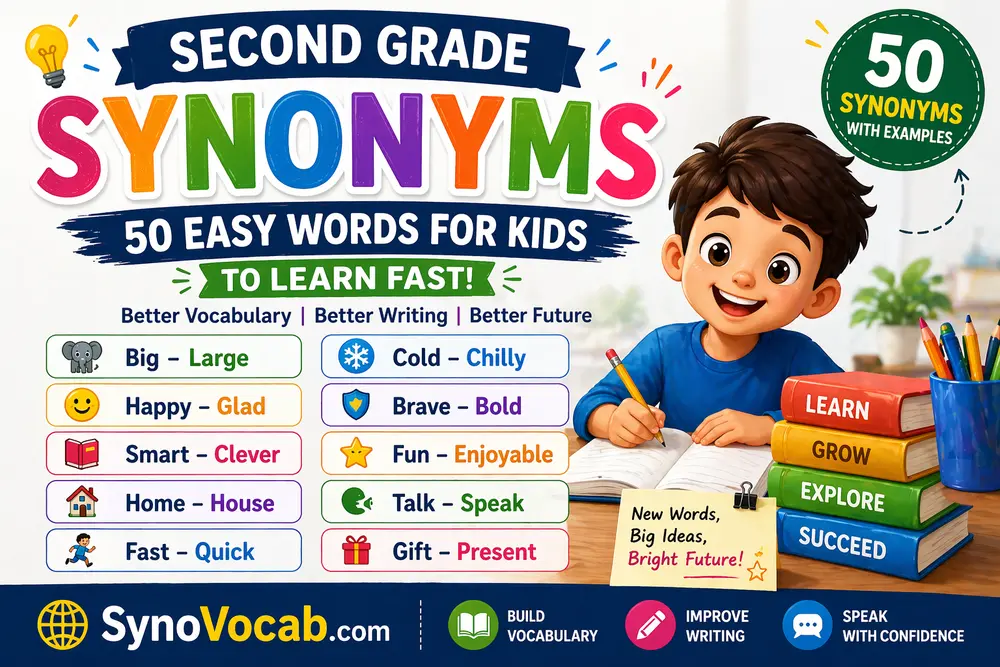
Have you ever noticed that some words mean the same thing? For example, big and large both mean almost the same. These are called synonyms.
In second grade, learning synonyms is very important. It helps kids read better, write better, and speak clearly. When children know more words, they can express their ideas in a fun and smart way.
For example, instead of saying “happy” again and again, a child can say “glad” or “joyful.” That makes sentences more interesting.
That’s why learning second grade synonyms is a great step for young learners. Below, you’ll find 50 simple synonym pairs with meanings and easy examples that kids can understand and use daily.
1. Big – Large
Meaning: Something that is not small.
Examples:
The dog is big.
The house is large.
2. Small – Tiny
Meaning: Something little in size.
Examples:
The cat is small.
The bug is tiny.
3. Happy – Glad
Meaning: Feeling good or joyful.
Examples:
She is happy today.
He is glad to see you.
4. Sad – Unhappy
Meaning: Feeling bad or down.
Examples:
She feels sad.
He is unhappy today.
5. Fast – Quick
Meaning: Moving with speed.
Examples:
The car is fast.
The rabbit is quick.
6. Slow – Sluggish
Meaning: Moving without speed.
Examples:
The turtle is slow.
The snail is sluggish.
7. Hot – Warm
Meaning: Having heat.
Examples:
The tea is hot.
The water is warm.
8. Cold – Chilly
Meaning: Not warm.
Examples:
The ice is cold.
The air is chilly.
9. Easy – Simple
Meaning: Not hard to do.
Examples:
This work is easy.
The question is simple.
10. Hard – Difficult
Meaning: Not easy.
Examples:
The test is hard.
The task is difficult.
11. Smart – Clever
Meaning: Good at thinking.
Examples:
She is smart.
He is clever.
12. Brave – Bold
Meaning: Not afraid.
Examples:
The boy is brave.
The girl is bold.
13. Funny – Silly
Meaning: Makes you laugh.
Examples:
The clown is funny.
He is silly.
14. Kind – Nice
Meaning: Caring and good.
Examples:
She is kind.
He is nice.
15. Angry – Mad
Meaning: Feeling upset.
Examples:
He is angry.
She is mad.
16. Loud – Noisy
Meaning: Making strong sound.
Examples:
The music is loud.
The class is noisy.
17. Quiet – Silent
Meaning: No sound.
Examples:
The room is quiet.
The night is silent.
18. Start – Begin
Meaning: To begin something.
Examples:
Let’s start now.
We begin the game.
19. End – Finish
Meaning: To stop or complete.
Examples:
The show will end.
I will finish work.
20. Look – See
Meaning: To use your eyes.
Examples:
Look at the sky.
I see a bird.
21. Run – Sprint
Meaning: To move fast on feet.
Examples:
He can run fast.
She will sprint.
22. Walk – Stroll
Meaning: To move slowly.
Examples:
We walk daily.
They stroll in park.
23. Jump – Hop
Meaning: To move up.
Examples:
He can jump high.
The frog can hop.
24. Talk – Speak
Meaning: To say words.
Examples:
We talk daily.
She can speak well.
25. Ask – Question
Meaning: To request an answer.
Examples:
I ask a question.
He will question it.
26. Help – Assist
Meaning: To support someone.
Examples:
I help my mom.
He assists his friend.
27. Buy – Purchase
Meaning: To get something with money.
Examples:
I buy a toy.
She will purchase a book.
28. Make – Create
Meaning: To build or form something.
Examples:
I make a cake.
She will create art.
29. Job – Work
Meaning: Something you do.
Examples:
He has a job.
She likes her work.
30. Home – House
Meaning: Place to live.
Examples:
I love my home.
The house is big.
31. Friend – Buddy
Meaning: A close person.
Examples:
He is my friend.
She is my buddy.
32. Baby – Infant
Meaning: A very young child.
Examples:
The baby is sleeping.
The infant is calm.
33. Teacher – Tutor
Meaning: A person who teaches.
Examples:
My teacher is kind.
The tutor helps me.
34. Student – Pupil
Meaning: A person who learns.
Examples:
He is a student.
She is a pupil.
35. School – Academy
Meaning: A place to learn.
Examples:
I go to school.
The academy is nice.
36. Book – Text
Meaning: Something to read.
Examples:
I read a book.
This text is easy.
37. Story – Tale
Meaning: A short story.
Examples:
I like this story.
This tale is fun.
38. Game – Play
Meaning: Something fun to do.
Examples:
We play a game.
Let’s play outside.
39. Food – Meal
Meaning: Something to eat.
Examples:
The food is tasty.
The meal is ready.
40. Water – Drink
Meaning: Liquid to drink.
Examples:
Drink water daily.
This drink is cold.
41. Car – Vehicle
Meaning: Something to travel.
Examples:
The car is fast.
The vehicle is new.
42. Road – Street
Meaning: Path for travel.
Examples:
The road is long.
The street is busy.
43. City – Town
Meaning: A place with people.
Examples:
The city is big.
The town is small.
44. Farm – Field
Meaning: Place to grow crops.
Examples:
The farm is green.
The field is wide.
45. Animal – Creature
Meaning: A living being.
Examples:
The animal is big.
The creature is small.
46. Dog – Puppy
Meaning: A young dog.
Examples:
The dog is loud.
The puppy is cute.
47. Cat – Kitten
Meaning: A young cat.
Examples:
The cat is soft.
The kitten is small.
48. Bird – Chick
Meaning: A baby bird.
Examples:
The bird can fly.
The chick is small.
49. Day – Morning
Meaning: Time of light.
Examples:
The day is bright.
The morning is fresh.
50. Night – Evening
Meaning: Time of dark.
Examples:
The night is calm.
The evening is cool.
Why Second Grade Synonyms Matter
Learning synonyms in second grade helps kids grow their vocabulary in a fun and simple way. When children know more words, they can speak clearly and write better sentences. It also helps them understand stories and lessons faster.
Using different words like big, large, or tiny makes language more interesting. Kids feel more confident when they can express their ideas in many ways. That’s why practicing synonyms daily is a smart step for early learning and strong communication skills.
Conclusion
Learning second grade synonyms helps kids build strong vocabulary in a fun and simple way. It makes reading easier and writing more exciting. When children use different words with the same meaning, they sound smarter and more confident. I suggest practicing these words daily in speaking, writing, and schoolwork. The more you use them, the better your English will become.

I am Rana Fareed, an educator and content writer with an MPhil in Business Administration and an LLB (Law) degree. I write on current affairs, English language topics, and synonyms, simplifying complex ideas for everyday readers. Alongside teaching, I am passionate about helping people improve their knowledge and communication skills.