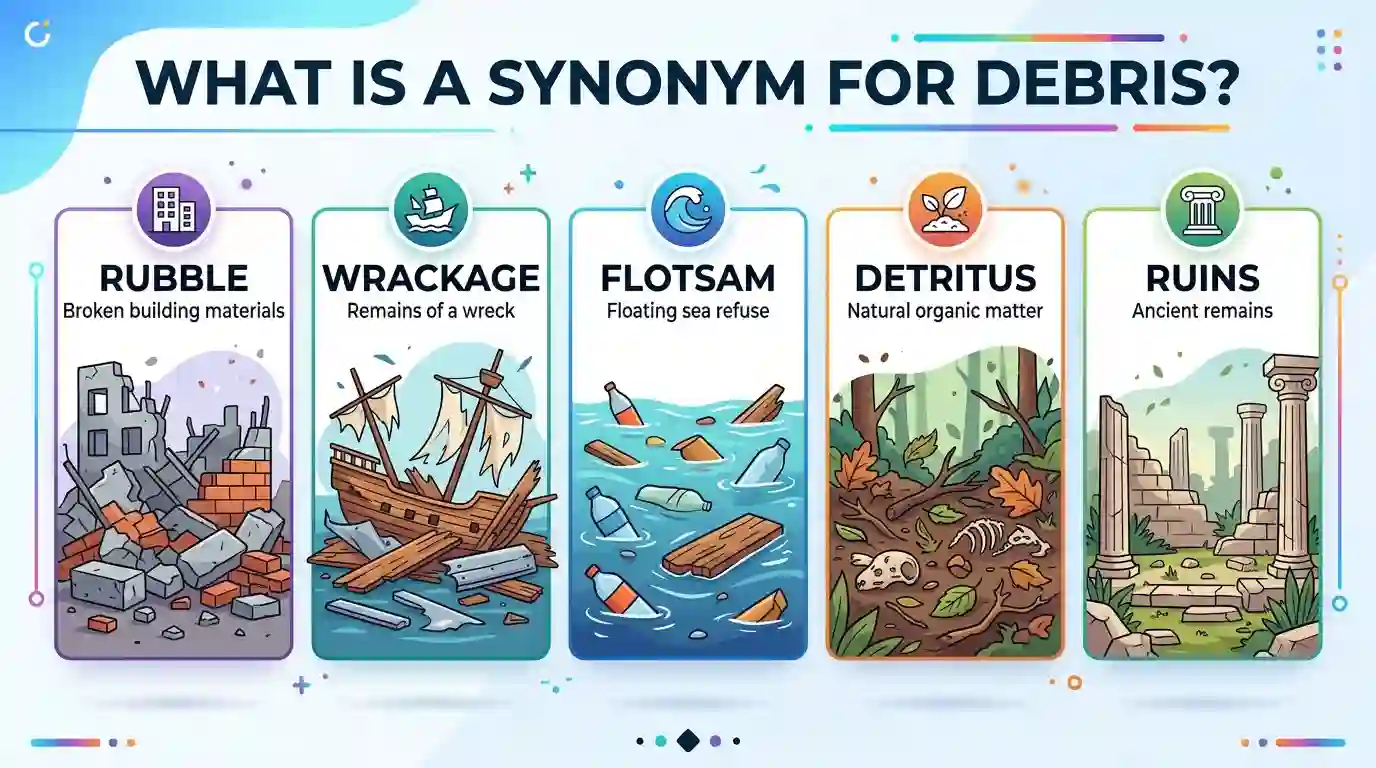
A synonym for debris is rubble, which refers to broken pieces of stone, brick, or other building materials. Other synonyms include fragments, remains, wreckage, detritus, trash, and litter. The best alternative depends on the context. Use wreckage for the remains of a damaged vehicle, trash for unwanted waste, and fragments for broken pieces of an object.
Key Takeaways
- Rubble is a strong choice for broken bricks, stones, and buildings.
- Wreckage describes the remains of a damaged or destroyed vehicle, aircraft, or structure.
- Fragments refers to individual pieces broken off from something larger.
- Trash, litter, and waste work best when debris refers to unwanted material.
- Detritus is a more formal word for material left behind after a process or event.
What Does Debris Mean?
Debris is a noun that describes scattered pieces of material left after something breaks, gets damaged, or wears away. It can include broken glass, fallen branches, damaged building materials, or unwanted bits of rubbish.
For example, after a powerful storm, a street might contain leaves, branches, roof shingles, and pieces of broken fencing. Together, these materials can be called debris.
The word also appears in scientific and environmental contexts. Plant debris can include fallen leaves and twigs, while space debris refers to human-made objects and fragments left in orbit.
According to Cambridge Dictionary, debris includes broken or torn pieces of something larger. This meaning explains why several synonyms overlap but are not always interchangeable.
How to Pronounce Debris
In American English, debris is commonly pronounced duh-BREE. Another pronunciation, day-BREE, is also recognized. The final s is silent.
Debris is generally an uncountable noun. Therefore, standard expressions include:
- A pile of debris
- Pieces of debris
- A large amount of debris
- Debris from the storm
In most everyday writing, avoid using debrises as the plural form.
12 Best Synonyms for Debris
The following alternatives cover common situations in everyday writing, school assignments, news reports, and professional communication.
| Synonym | Best use | Example |
|---|---|---|
| Rubble | Broken building materials | Workers cleared the rubble. |
| Fragments | Individual broken pieces | Glass fragments covered the floor. |
| Remains | What is left of something | Investigators examined the remains. |
| Wreckage | Damaged vehicles or structures | Crews searched the wreckage. |
| Detritus | Material left behind | Leaves and other detritus filled the pond. |
| Trash | Unwanted or discarded items | Volunteers collected trash from the beach. |
| Litter | Waste scattered in public places | Litter covered the roadside. |
| Waste | Unwanted material | The factory removed construction waste. |
| Scrap | Leftover or discarded material | The mechanic recycled metal scrap. |
| Shards | Sharp pieces of broken glass or similar materials | Shards lay beside the window. |
| Clutter | Disorganized objects in a space | She removed the clutter from the garage. |
| Ruins | The remains of a damaged or destroyed building or place | Tourists explored the ancient ruins. |
These words share part of the meaning of debris, but each highlights a different feature. Choose the word that describes the material or situation most accurately.
How to Choose the Right Synonym for Debris
The easiest way to select a replacement is to identify what the debris consists of and how it got there.
Debris vs. Rubble
Rubble usually means broken stones, bricks, concrete, and similar building materials. Debris is broader and can describe many kinds of scattered material.
- Original: The workers removed debris from the collapsed wall.
- Alternative: The workers removed rubble from the collapsed wall.
The second sentence works especially well when the material consists mainly of broken masonry.
Debris vs. Wreckage
Wreckage refers to the remains of something badly damaged or destroyed, particularly a vehicle, aircraft, ship, or large structure.
- Original: Investigators examined the debris after the plane crash.
- Alternative: Investigators examined the wreckage after the plane crash.
Wreckage emphasizes the damaged object and its remains. Debris can also include smaller pieces scattered around the crash site.
Debris vs. Detritus
Detritus is a more formal term for material left behind after something breaks down, decays, or goes through a process. It appears in environmental, scientific, and literary writing.
- Original: The pond collected leaves and other debris.
- Alternative: The pond collected leaves and other detritus.
Detritus is particularly suitable for natural material, such as decaying leaves and plant matter. However, it can also describe leftover material in other contexts.
Debris vs. Trash and Litter
Trash means unwanted or discarded material. Litter usually refers to waste left scattered in places where it does not belong, such as sidewalks, beaches, and parks.
- Original: The cleanup team removed debris from the beach.
- Using trash: The cleanup team removed trash from the beach.
- Using litter: Volunteers picked up litter along the beach.
Use trash when emphasizing discarded material and litter when emphasizing waste scattered around a place. If the material consists of driftwood, seaweed, and broken natural objects, debris may be more accurate than either word.
Examples of Debris in Different Contexts
The right synonym often depends on the setting. These examples show how to make your writing more precise.
1. After a storm
- Original: Debris covered the driveway.
- Better alternative: Fallen branches and storm debris covered the driveway.
- Another option: Branches and broken fence pieces littered the driveway.
2. At a construction site
- Original: Workers cleared the debris from the building.
- Better alternative: Workers cleared the rubble from the collapsed building.
- Another option: Workers removed construction waste from the site.
3. After a vehicle accident
- Original: Debris was scattered across the highway.
- Better alternative: Vehicle wreckage and broken glass were scattered across the highway.
- Another option: Fragments of the damaged vehicle covered part of the road.
4. In a garden or pond
- Original: Debris blocked the water.
- Better alternative: Leaves and twigs blocked the water.
- Another option: Plant detritus accumulated near the pond’s drain.
5. In space
- Original: Scientists study debris orbiting Earth.
- Better alternative: Scientists study orbital debris.
- Another option: Researchers monitor fragments from defunct satellites.
In each case, the more specific wording tells readers exactly what the material is rather than relying on a broad term.
Common Mistakes When Using Debris
Choosing a synonym requires more than finding a word with a similar dictionary definition. Watch out for these common mistakes.
Using rubble for every kind of debris. Rubble generally suggests broken stone or building material. It is not the most natural choice for fallen leaves, household rubbish, or small pieces of plastic.
Using wreckage for ordinary litter. Wreckage suggests serious damage to a vehicle, structure, or similar object. It would sound unusual to describe a few candy wrappers as wreckage.
Using detritus in casual conversation. Detritus is correct in many contexts, but debris, waste, or leftover material may sound more natural in everyday speech.
Treating debris as a countable plural noun. In ordinary usage, debris is uncountable. Write some debris, a pile of debris, or several pieces of debris, rather than many debris.
Ignoring the intended meaning. Not every synonym can replace debris without changing the sentence. Read the whole sentence before selecting an alternative.
Frequently Asked Questions
What is the best synonym for debris?
Rubble is often the best synonym when debris consists of broken building materials. For a broader meaning, fragments or remains may fit better. If the material is unwanted waste, consider trash or litter. The original sentence determines which alternative sounds most natural.
What is a formal word for debris?
Detritus is a useful formal alternative. It often describes material left behind through decay, wear, or a process. Fragments and remains can also work in formal writing, depending on the context. In technical writing, the most precise term is usually better than the most sophisticated-sounding one.
Is rubble another word for debris?
Yes. Rubble is a type of debris, especially broken bricks, stones, and concrete. However, debris can also include leaves, plastic, metal, glass, and other scattered materials. Use rubble when you want to emphasize broken masonry rather than mixed material.
What is the difference between debris and wreckage?
Debris describes scattered pieces of material left after damage, destruction, or a natural process. Wreckage specifically emphasizes the remains of something badly damaged or destroyed, such as a plane or car. A crash site may contain both wreckage and debris scattered around it.
What is the difference between debris and detritus?
Debris commonly refers to scattered pieces of broken or unwanted material. Detritus often refers to material left behind after decay, breakdown, or a process. The words overlap, especially in environmental writing, but detritus can sound more formal or scientific.
How do you use debris in a sentence?
You can write, “After the storm, volunteers cleared debris from the road.” Other examples include “The drain was blocked by garden debris” and “Investigators examined the debris from the damaged vehicle.” The word works in everyday, environmental, scientific, and news-related writing.
Is debris singular or plural?
Debris is generally an uncountable noun in English, so it does not normally take a plural -s. Use phrases such as a piece of debris, several pieces of debris, or a large amount of debris. The word itself stays the same.
Conclusion
The best synonym for debris depends on the material and situation. Choose rubble for broken building materials, wreckage for damaged vehicles or structures, fragments for individual broken pieces, and trash or litter for discarded waste. For a more formal alternative, consider detritus.
When you replace debris in a sentence, focus on the exact meaning you want to communicate. A precise synonym makes your writing clearer, more natural, and easier to understand.

I am Abubakar, an educator and content writer with a Master’s degree in English Language. I write about English language, vocabulary, and educational topics, simplifying complex concepts for everyday readers. Alongside my passion for teaching and learning, I focus on creating helpful and engaging content that improves knowledge, communication skills, and language understanding.