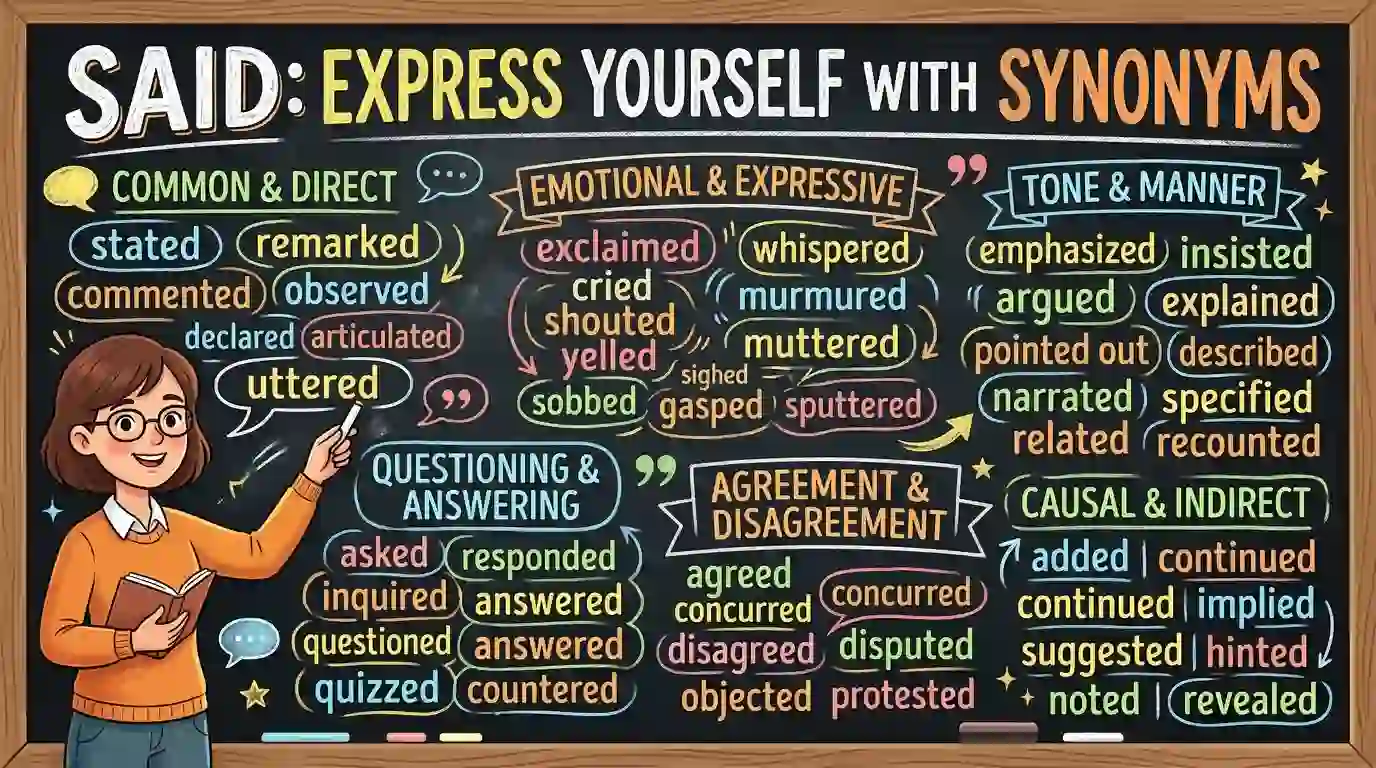
A synonym for said is a word that describes how someone speaks or communicates. Common alternatives include stated, replied, remarked, explained, whispered, shouted, admitted, and declared. The best choice depends on the context. Use neutral words for everyday dialogue, formal verbs for reports, and expressive verbs when a character’s tone or emotion matters.
Key Takeaways
- Stated, remarked, replied, and mentioned work well in many everyday and formal situations.
- Use whispered, shouted, snapped, or murmured when the way someone speaks matters.
- Choose admitted, insisted, claimed, or confessed when the speaker’s intention or attitude is important.
- In academic writing, verbs such as reported, argued, noted, and observed can clarify what a source contributes.
- You do not need to replace said every time. A simple dialogue tag often keeps writing clear and natural.
What Is a Synonym for Said?
A synonym for said is another word that can describe expressing something in speech or, in some contexts, communicating information in writing.
For example:
- Original: “I understand,” Maya said.
- Alternative: “I understand,” Maya replied.
Both sentences identify the speaker’s words. However, replied specifically suggests that Maya is responding to something said earlier.
Not every alternative has exactly the same meaning. Whispered describes low-volume speech, while admitted suggests acknowledging something. Choosing the right verb helps readers understand what is happening without adding unnecessary explanation.
Best Synonyms for Said by Writing Style
1. Neutral and Everyday Alternatives
These words work when you want to report speech without adding too much emotion.
| Synonym | Meaning or use | Example |
|---|---|---|
| Replied | Responded to someone | “I’m ready,” she replied. |
| Remarked | Made a comment | “That’s unusual,” he remarked. |
| Mentioned | Referred to something | She mentioned the meeting. |
| Added | Included more information | “We also need paper,” he added. |
| Answered | Responded to a question | “It’s upstairs,” she answered. |
| Commented | Expressed an opinion | “The room looks better,” he commented. |
| Noted | Pointed out something | The teacher noted the improvement. |
| Explained | Made something clearer | He explained the problem. |
| Observed | Made a remark based on what was noticed | “The road is wet,” she observed. |
| Responded | Reacted with words | “That sounds fair,” he responded. |
Best tip: Use replied for a response, explained for clarification, and mentioned for a brief reference. These words are related to said, but their meanings are not interchangeable in every sentence.
2. Formal Synonyms for Said
Formal writing often benefits from precise reporting verbs rather than dramatic dialogue tags. These alternatives are useful in essays, business reports, news summaries, and professional communication.
| Synonym | Best use | Example |
|---|---|---|
| Stated | Expressing information directly | The report stated that costs had increased. |
| Declared | Making a firm or public announcement | The mayor declared the event open. |
| Asserted | Expressing a position confidently | The researcher asserted that more evidence was needed. |
| Reported | Presenting information or findings | The team reported a rise in sales. |
| Indicated | Showing or suggesting information | The results indicated a possible change. |
| Announced | Sharing news publicly | The company announced a new policy. |
| Confirmed | Verifying information | The manager confirmed the appointment. |
| Acknowledged | Recognizing a fact or concern | The director acknowledged the delay. |
| Emphasized | Giving special importance to a point | The professor emphasized the need for accuracy. |
| Argued | Giving reasons to support a position | The author argued that education should be affordable. |
Use these verbs according to what the speaker actually did. For example, confirmed implies verification, while argued suggests reasoning in support of a position.
3. Emotional Synonyms for Said
In fiction and storytelling, a dialogue tag can reveal emotion, attitude, or speaking volume. Choose a word that matches the scene rather than simply trying to make the writing sound dramatic.
| Emotion or tone | Synonyms for said | Example |
|---|---|---|
| Anger | snapped, growled, barked | “Leave me alone,” he snapped. |
| Excitement | exclaimed, cheered, shouted | “We won!” she exclaimed. |
| Sadness | sobbed, murmured, whispered | “I miss you,” she whispered. |
| Fear | stammered, whimpered, cried | “I heard something,” he stammered. |
| Uncertainty | hesitated, murmured, ventured | “Maybe we should wait,” she ventured. |
| Confidence | asserted, declared, insisted | “I can handle it,” she asserted. |
| Humor | joked, teased, quipped | “Nice timing,” he quipped. |
| Frustration | grumbled, complained, muttered | “This never works,” she grumbled. |
| Relief | sighed, breathed, exclaimed | “Finally, we’re safe,” he breathed. |
| Urgency | warned, urged, demanded | “Get out now!” she warned. |
Remember that some of these words describe how a person speaks, while others describe what the person is doing with their words. For instance, warned signals a potential danger, and demanded suggests a forceful request.
Synonyms for Said by Emotion and Tone
Sometimes, you know the feeling you want to express but are unsure which verb fits best. Use these quick lists to narrow your options.
- Said angrily: snapped, growled, barked, snarled, retorted.
- Said quietly: murmured, whispered, muttered, mumbled.
- Said loudly: shouted, yelled, bellowed, screamed.
- Said happily: exclaimed, cheered, gushed, laughed.
- Said sadly: sobbed, lamented, moaned, whispered.
- Said confidently: asserted, declared, maintained, insisted.
- Said uncertainly: hesitated, stammered, faltered, ventured.
- Said politely: replied, noted, remarked, acknowledged.
- Said sarcastically: scoffed, quipped, retorted, sneered.
- Said urgently: urged, warned, pleaded, demanded.
Examples in Context
Consider how one line changes when you use a more specific verb.
Neutral: “I don’t agree,” Daniel said.
Angry: “I don’t agree,” Daniel snapped.
Uncertain: “I don’t agree,” Daniel hesitated.
Firm: “I don’t agree,” Daniel insisted.
Each version creates a different impression. However, hesitated works best when the character shows uncertainty, while insisted suggests determination. The verb should match the character’s behavior and the meaning of the dialogue.
How to Choose the Right Synonym for Said
Use these four steps to find the most suitable word.
- Identify the purpose. Is the speaker answering, explaining, arguing, warning, or announcing something?
- Consider the tone. Does the speaker sound calm, angry, excited, uncertain, or formal?
- Check the meaning. Make sure the alternative does not add an emotion or intention that the original sentence does not support.
- Read the sentence aloud. If the word sounds forced, return to said or rewrite the sentence.
For example, consider this line:
“You’re going to miss the train,” Alex said.
If Alex is simply sharing information, said is fine. If Alex is alerting someone to danger or a problem, warned may fit better. And If Alex is urging the person to hurry, urged could be more accurate.
The best word is the one that communicates the intended meaning, not necessarily the most unusual one.
Said vs. Stated vs. Declared vs. Claimed
These four words are related, but each carries a different meaning.
| Word | Main difference | Example |
|---|---|---|
| Said | Neutral reporting of speech | “I’ll return tomorrow,” she said. |
| Stated | Presents information directly or formally | The notice stated that the office was closed. |
| Declared | Makes a firm or public announcement | “I accept the challenge,” he declared. |
| Claimed | Reports an assertion that may need verification | He claimed that he had finished the work. |
Which one should you use?
Choose said for ordinary conversation. Use stated for direct, formal communication. Choose declared when a statement is forceful or official. Use claimed when reporting an assertion without necessarily confirming that it is true.
These distinctions matter in news writing, academic work, and professional communication because a reporting verb can influence how readers interpret a statement.
Should You Always Replace Said?
No. Replacing every instance of said can make writing less natural.
In fiction, readers often focus on the dialogue itself and pay little attention to a simple tag. An unusual verb can draw attention away from the character’s words, especially when it adds no useful information. Writing advice from Reedsy also emphasizes choosing dialogue tags carefully rather than avoiding said at all costs. <a href=”https://reedsy.com/blog/guide/how-to-write-dialogue/other-words-for-said/” target=”_blank” rel=”noopener noreferrer”>Read Reedsy’s dialogue-writing guide.</a>
You can also replace a dialogue tag with an action beat when the character’s behavior tells the reader enough.
With a dialogue tag:
“I’m not leaving,” Mia said angrily.
With an action beat:
“I’m not leaving.” Mia folded her arms and stepped toward the door.
The second version shows Mia’s determination through her actions instead of explaining her emotion directly.
One important grammar point: action beats are not dialogue tags. For example, smiled describes an action rather than a way of speaking. Instead of writing, “I agree,” he smiled, write, “I agree.” He smiled. Alternatively, use said with a smile when the words and action belong in the same sentence.
Frequently Asked Questions
What is the most common synonym for said?
There is no single best replacement for every situation. Replied, stated, remarked, and mentioned are useful alternatives, but their meanings differ. Use replied when someone answers, stated for a direct statement, remarked for a comment, and mentioned for a brief reference.
What is a formal word for said?
Stated, reported, asserted, declared, and noted are useful formal alternatives. The right choice depends on the context. For example, a researcher might report findings, an author might argue a position, and a report might state a conclusion.
What is another word for said angrily?
Words such as snapped, growled, barked, snarled, and retorted can suggest anger or hostility. Choose the word based on the intensity and manner of speech. Snapped often suggests a sharp response, while retorted emphasizes a quick or pointed reply.
How can I avoid repeating said in a story?
Use a mix of simple dialogue tags, occasional expressive verbs, and action beats. You can also omit a tag when it is clear who is speaking. Focus on making the conversation natural instead of replacing every instance of said with a different word.
Is said acceptable in academic writing?
Yes, but academic writing often benefits from more precise reporting verbs. Depending on the source and context, use argues, reports, observes, notes, states, or concludes. Do not choose a stronger verb unless the source genuinely performs that action.
Conclusion
The best synonym for said depends on what you want your reader to understand. Use replied for answers, stated for formal information, whispered for quiet speech, and snapped for a sharp response. In essays, select reporting verbs that accurately represent the source. In fiction, let the dialogue and characters’ actions do some of the work.
You do not need to eliminate said. Use alternatives when they add meaning, clarify tone, or make your writing more precise.

I am Rana Fareed, an educator and content writer with an MPhil in Business Administration and an LLB (Law) degree. I write on current affairs, English language topics, and synonyms, simplifying complex ideas for everyday readers. Alongside teaching, I am passionate about helping people improve their knowledge and communication skills.