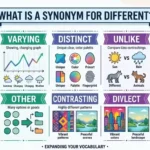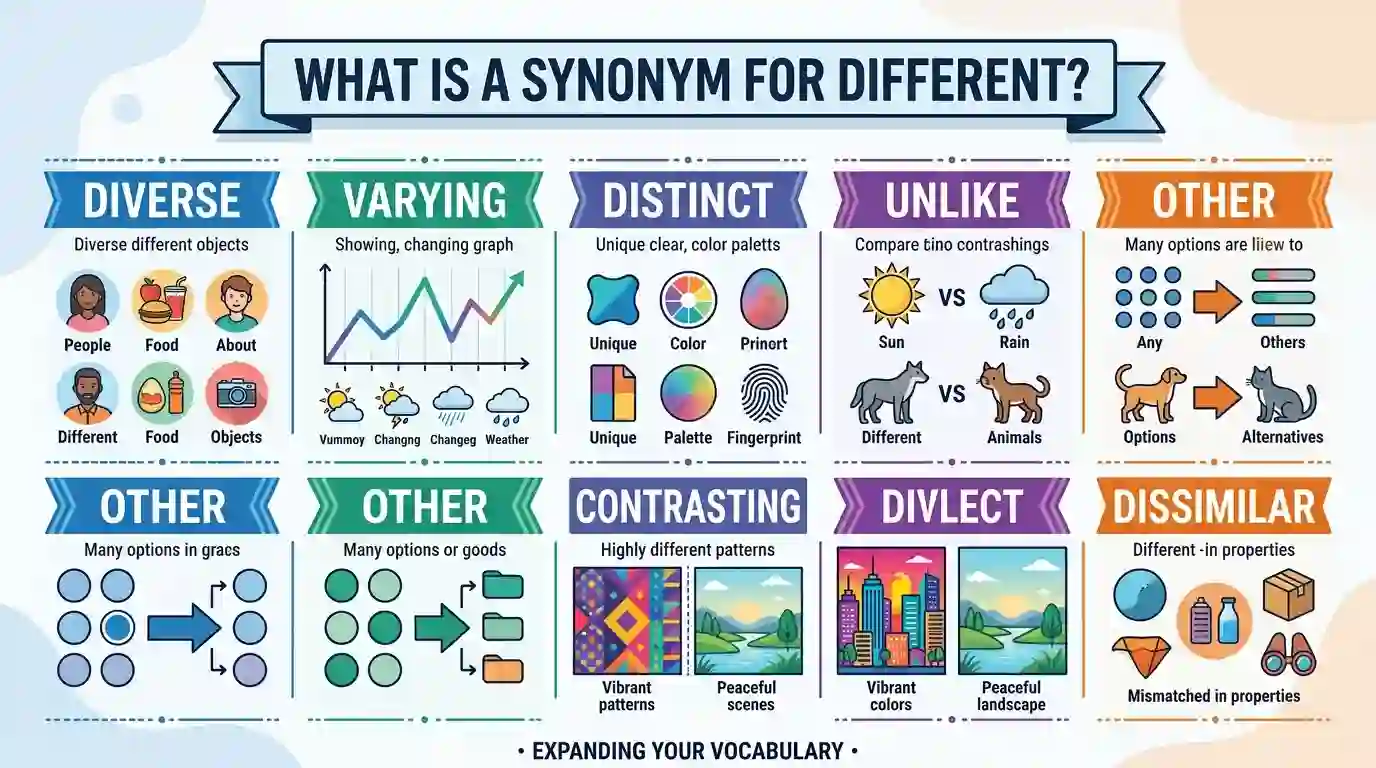
A synonym for different is dissimilar, which means not alike or not the same. Other useful synonyms include distinct, unlike, diverse, various, separate, unusual, and unique. The best choice depends on your meaning. Use dissimilar to compare things, diverse for variety, distinct for clear differences, and unusual for something outside the ordinary.
Key Takeaways
- Dissimilar is a strong choice when comparing things that are not alike.
- Distinct describes things that are clearly separate or recognizable.
- Diverse and various emphasize variety.
- Unusual, unique, and unconventional describe things that stand out from the ordinary.
- Choose a synonym based on the sentence, tone, and meaning you want to express.
What Does Different Mean?
The word different is an adjective that describes something that is not the same as another thing. It can refer to differences in appearance, behavior, quality, opinion, style, or type.
For example:
- Everyday use: My new phone is different from my old one.
- Academic writing: The researchers examined different approaches to the problem.
- Creative writing: She has a different way of looking at the world.
According to the Cambridge Dictionary, different can describe things that are unlike each other, separate, or unusual.
English meaning – Cambridge Dictionary
+1
Because the word has several meanings, no single synonym works in every situation. Understanding the context helps you select a more precise alternative.
25 Synonyms for Different With Examples
The following words offer alternatives for everyday conversations, school assignments, professional documents, and creative writing.
Words That Mean Not the Same
These synonyms work well when you want to compare two or more people, objects, ideas, or situations.
| Synonym | Meaning | Example sentence |
|---|---|---|
| Dissimilar | Not alike | The two designs are dissimilar in shape. |
| Unlike | Not similar to | Unlike his brother, Jake enjoys reading. |
| Distinct | Clearly different or separate | Each department has a distinct role. |
| Separate | Kept apart or treated individually | We discussed two separate issues. |
| Divergent | Moving or developing in different directions | The teams followed divergent strategies. |
| Disparate | Very different in nature or type | The study combined disparate sources of evidence. |
| Unalike | Not alike | The sisters are unalike in personality. |
| Contrasting | Showing clear differences | The room features contrasting colors. |
| Unequal | Not equal in amount, value, or status | The two groups received unequal resources. |
| Unrelated | Not connected in a meaningful way | The comments addressed unrelated topics. |
Best choice: Use dissimilar for general comparisons, distinct when differences are easy to recognize, and divergent when ideas or paths move in different directions.
Words That Mean Unusual or Unique
Sometimes, different describes a person, idea, design, or behavior that stands out from what people normally expect.
| Synonym | Meaning | Example sentence |
|---|---|---|
| Unusual | Not commonly seen | She chose an unusual color for the walls. |
| Unique | One of a kind or distinctive | The artist developed a unique style. |
| Unconventional | Not following usual customs | He proposed an unconventional solution. |
| Distinctive | Having recognizable qualities | Her distinctive voice stood out. |
| Peculiar | Strange or unusual | We noticed a peculiar sound outside. |
| Extraordinary | Remarkable or beyond the ordinary | The team achieved extraordinary results. |
| Uncommon | Not frequently found | That bird is uncommon in this region. |
| Novel | New or original | The company introduced a novel approach. |
| Atypical | Not representative of what is usual | The results showed an atypical pattern. |
| Offbeat | Unusual in an interesting way | The café has an offbeat interior design. |
Best choice: Use unusual for something uncommon, unique for something especially distinctive, and unconventional for an approach that goes against established practices.
Be careful with peculiar because it can suggest that something is strange. Likewise, unique is stronger than simply being different. Two things can be different without either being one of a kind.
Words That Mean Several or Varied
In some sentences, different means that multiple types, choices, or categories exist. In these cases, the following words may sound more natural.
| Synonym | Meaning | Example sentence |
|---|---|---|
| Various | Several different types or examples | We considered various options. |
| Diverse | Including a wide range of types | The organization serves a diverse community. |
| Varied | Including different forms or experiences | The course offers varied activities. |
| Assorted | Made up of different items | The box contains assorted snacks. |
| Miscellaneous | Consisting of different, unrelated items | She stored miscellaneous papers in a folder. |
| Alternative | Available as another option | We need an alternative plan. |
Best choice: Use various when referring to several options, diverse when emphasizing a broad range, and varied when describing differences within a collection or experience.
These words are related, but they are not interchangeable in every sentence. For instance, a diverse group contains a range of characteristics, while various choices simply refers to multiple options.
Cambridge English Thesaurus article page
+1
How to Choose the Best Synonym for Different
The easiest way to find the right alternative is to identify what you mean by different in your sentence.
When comparing two things
Use dissimilar, unlike, or distinct.
Example: The two proposals are dissimilar in cost and design.
When describing many types
Use diverse, various, or varied.
Example: The library offers a diverse selection of books.
When describing something uncommon
Use unusual, uncommon, or unconventional.
Example: The designer chose an unconventional layout.
When emphasizing originality
Use unique, novel, or distinctive.
Example: The author created a distinctive writing style.
When emphasizing strong contrast
Use contrasting, divergent, or disparate, depending on the context.
Example: The candidates presented divergent views on education.
A good synonym should preserve your original meaning while making the sentence clearer. If a replacement sounds unnatural or changes the meaning, keep the word different.
Different vs. Distinct vs. Diverse vs. Unique
These four words are common alternatives, but each emphasizes something slightly different.
| Word | Main emphasis | Example |
|---|---|---|
| Different | A general lack of sameness | The two plans are different. |
| Distinct | A clear or recognizable difference | The two plans have distinct goals. |
| Diverse | A wide range of types or characteristics | The team has diverse skills. |
| Unique | A quality that makes something one of a kind or especially distinctive | The building has a unique design. |
Consider these examples:
- “We have different opinions” simply says our opinions are not the same.
- “We have distinct opinions” emphasizes that the opinions are clearly distinguishable.
- “We have diverse opinions” suggests a range of viewpoints.
- “We have unique opinions” emphasizes their individuality, although it may sound less natural if you only mean that the opinions disagree.
The main lesson is simple: select the word that communicates the specific kind of difference you want to describe.
Synonyms for Different in Academic and Professional Writing
Choosing precise words can make essays, reports, emails, and business documents easier to understand.
Here are some practical substitutions.
| Original sentence | Improved alternative | Why it works |
|---|---|---|
| The study examined different methods. | The study examined various methods. | Emphasizes multiple methods. |
| The results were different. | The results were dissimilar. | Highlights a comparison. |
| The company used a different strategy. | The company adopted an alternative strategy. | Emphasizes another available approach. |
| The groups had different backgrounds. | The groups had diverse backgrounds. | Highlights a range of backgrounds. |
| The author presented a different argument. | The author presented a contrasting argument. | Emphasizes opposing ideas. |
| The project used a different technique. | The project used a novel technique. | Appropriate only if the technique was new or original. |
In academic writing, distinct, divergent, and disparate can add precision when they accurately describe the relationship between ideas or findings.
In business writing, alternative, various, and distinct are often useful. And in casual conversations, simpler expressions such as not the same, unlike, and not alike are usually clear and natural.
Do not choose a complicated word just to sound more formal. Accuracy matters more than vocabulary difficulty.
Common Mistakes When Using Synonyms for Different
Even words with similar definitions can create awkward or inaccurate sentences.
1. Using “unique” to mean any difference
Incorrect meaning: “My blue shirt is unique because it is a different color from yours.”
Better: “My blue shirt is a different color from yours.”
Unique is more suitable when the shirt has a special or one-of-a-kind quality.
2. Using “diverse” for every comparison
Awkward: “These two chairs are diverse in height.”
Better: “These two chairs are different in height.”
Diverse usually works better when describing a group with a range of types or characteristics.
3. Using “alternative” without an available choice
Awkward: “The two paintings have alternative colors.”
Better: “The two paintings have different colors.”
Alternative usually suggests another option or possible substitute.
4. Replacing “different” with a word that changes the meaning
For example, unequal refers to a lack of equality, while unrelated suggests a lack of connection. Neither word is a universal substitute for different.
5. Ignoring the sentence structure
Different synonyms may require different grammatical constructions. Check that your chosen word fits the rest of the sentence and expresses the intended relationship.
Frequently Asked Questions
What is the best synonym for different?
Dissimilar is a strong general alternative when comparing two things that are not alike. However, distinct may be better when emphasizing clear differences, diverse when describing variety, and unusual when describing something outside the ordinary.
What is a formal word for different?
Dissimilar, distinct, divergent, and disparate can work in formal writing. Choose the word that fits your meaning. For example, “The researchers observed divergent results” suggests that the results developed or differed in direction, while “The samples were dissimilar” simply describes a lack of similarity.
What is another word for very different?
Useful choices include vastly different, markedly different, strongly contrasting, dissimilar, and poles apart. For example, “The two approaches are vastly different” emphasizes a large difference. “The two opinions are poles apart” suggests an especially wide contrast.
What is the opposite of different?
Common antonyms include same, similar, alike, identical, and comparable. The best choice depends on the context. Identical means exactly the same in the relevant respects, while similar means alike without necessarily being exactly the same.
thesaurus.com
+1
Is “different than” grammatically correct?
Yes. In American English, both different from and different than are standard constructions. For example, “This result is different from the earlier result” and “The result is different than we expected” are both acceptable. Different from is a versatile choice, especially in formal writing.
Dictionary.com
+1
Conclusion
The best answer to “what is a synonym for different” depends on the meaning you want to express. Dissimilar is useful for comparisons, distinct emphasizes clear differences, diverse highlights variety, and unusual describes something uncommon.
For everyday writing, you can often use unlike, not the same, or various. For academic and professional writing, choose more precise words such as divergent, distinct, or disparate when appropriate.
Instead of replacing different automatically, consider the context first. The right synonym makes your writing clearer, more natural, and more accurate.

I am Rana Fareed, an educator and content writer with an MPhil in Business Administration and an LLB (Law) degree. I write on current affairs, English language topics, and synonyms, simplifying complex ideas for everyday readers. Alongside teaching, I am passionate about helping people improve their knowledge and communication skills.