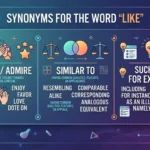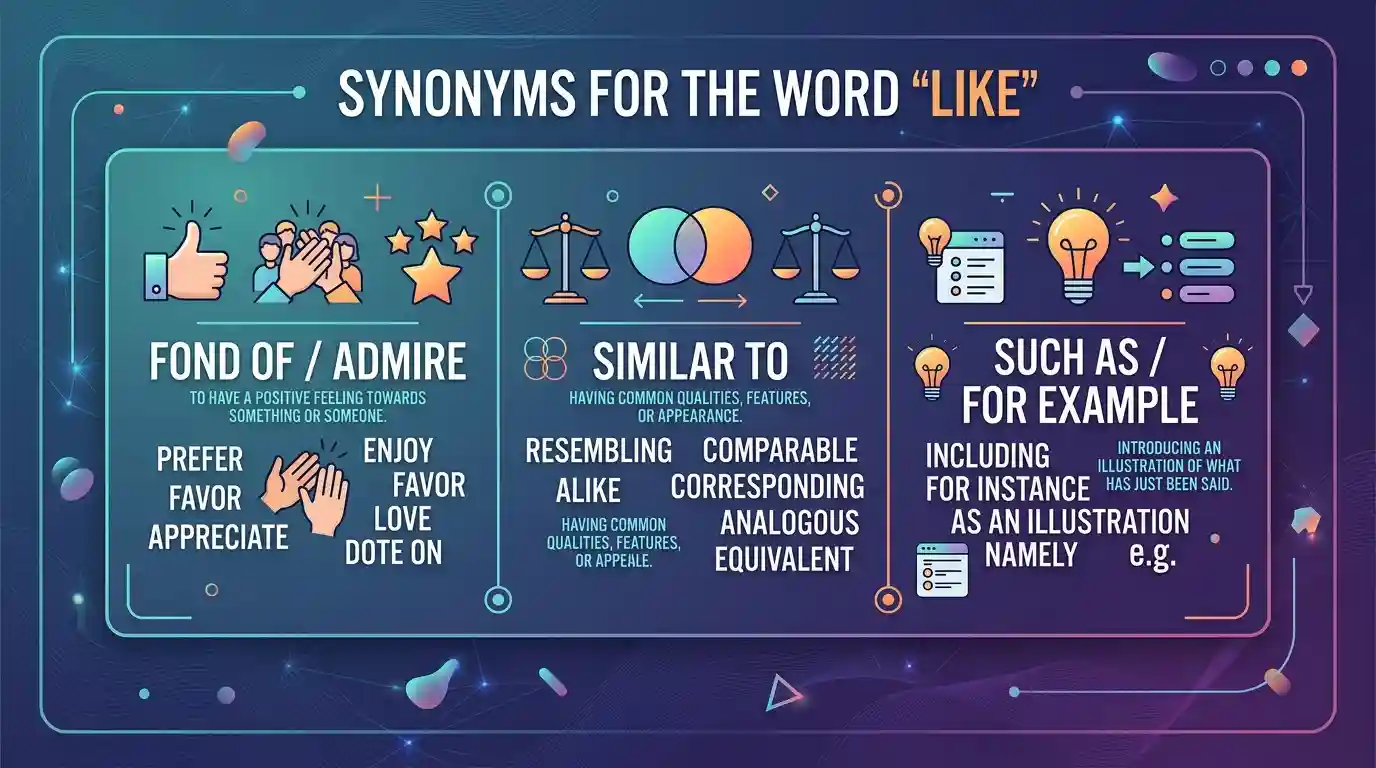
A synonym for like depends on the meaning you want to express. When you enjoy something, use enjoy, love, or be fond of. When you value someone or something, try appreciate or admire. And when you compare two things, use similar, alike, or resemble. The best alternative depends on your sentence and intended meaning.
Key Takeaways
- Enjoy is a strong everyday alternative when you find something pleasurable.
- Appreciate and admire express respect or recognition of value.
- Prefer means you choose one option over another.
- Similar, alike, and resemble describe things that share characteristics.
- Always choose a synonym that fits your sentence instead of replacing “like” automatically.
What Does “Like” Mean?
The word like has several meanings in American English. It can express enjoyment, affection, approval, preference, or similarity. It can also introduce examples or appear as a conversational filler.
For example:
- Enjoyment: I like reading mystery novels.
- Affection: I like my new neighbors.
- Preference: I like tea better than coffee.
- Similarity: This fabric looks like silk.
- Giving an example: Outdoor activities like hiking and camping can be relaxing.
Because these meanings differ, one synonym cannot replace like in every sentence. A word such as enjoy works for activities, while resemble works when describing similarities.
Understanding the intended meaning helps you choose a word that sounds natural and communicates your message clearly.
What Are the Best Synonyms for Like?
Here are 25 useful alternatives grouped by meaning and common usage.
1. Synonyms for Like Meaning Enjoy
Use these words when you want to describe pleasure, satisfaction, or a positive experience.
| Synonym | Meaning or nuance | Example sentence |
|---|---|---|
| Enjoy | Find something pleasurable | I enjoy reading before bed. |
| Love | Feel strong enjoyment or affection | She loves listening to jazz. |
| Appreciate | Recognize the value of something | I appreciate your thoughtful advice. |
| Be fond of | Have a warm liking for something | He is fond of old movies. |
| Relish | Enjoy something greatly | She relishes a good challenge. |
| Delight in | Take great pleasure in something | They delight in exploring new places. |
| Revel in | Enjoy an experience enthusiastically | He revels in the freedom of travel. |
| Favor | Show a preference for something | Many readers favor shorter chapters. |
Which word should you choose?
Enjoy is the safest everyday replacement for like when discussing activities or experiences. Love expresses stronger feelings. Relish and delight in are more expressive, while be fond of sounds warm and conversational.
For example:
- Basic: I like spending time outdoors.
- Clearer: I enjoy spending time outdoors.
- More expressive: I relish spending time outdoors.
These sentences communicate related ideas, but their tone and intensity differ.
2. Synonyms for Like Meaning Admire or Appreciate
Sometimes, like means more than finding something enjoyable. It can express approval, respect, or recognition of someone’s qualities.
| Synonym | Best use | Example |
|---|---|---|
| Admire | Respect someone’s qualities | I admire her determination. |
| Respect | Recognize someone’s worth or ability | We respect our coach. |
| Value | Consider something important | I value your honest opinion. |
| Cherish | Hold someone or something dear | She cherishes her childhood memories. |
| Esteem | Regard someone highly | The community esteems its teachers. |
| Approve of | Consider something acceptable | Her parents approve of the decision. |
These alternatives are not exact substitutes in every situation.
For example, “I like your honesty” expresses a positive feeling. “I admire your honesty” emphasizes respect for that quality. “I approve of your decision” expresses agreement rather than general enjoyment.
Choose the word that explains why you feel positively about a person, action, or idea.
3. Synonyms for Like Meaning Prefer
When like describes a choice or preference, alternatives such as prefer, favor, and would rather can make your meaning more precise.
| Alternative | Example |
|---|---|
| Prefer | I prefer walking to driving. |
| Favor | The committee favors the second proposal. |
| Choose | I choose the blue shirt over the red one. |
| Would rather | I would rather stay home tonight. |
| Be partial to | I’m partial to homemade pizza. |
| Be inclined toward | She is inclined toward practical solutions. |
Prefer is especially useful when comparing two or more options.
For example:
- Original: I like tea better than coffee.
- Improved: I prefer tea to coffee.
The second sentence states the preference directly and avoids unnecessary wording.
However, choose usually emphasizes making a decision, while prefer describes which option you like better. Use be partial to for a more conversational tone.
4. Synonyms for Like Meaning Similar
When like means “similar to” or “resembling,” enjoyment-related words will not work. Instead, choose an expression that describes shared qualities.
| Synonym | Meaning | Example |
|---|---|---|
| Similar | Having qualities in common | Their writing styles are similar. |
| Alike | Similar in appearance or qualities | The twins look alike. |
| Resemble | Look like or share features with | This building resembles a castle. |
| Akin to | Related or comparable in nature | Her approach is akin to traditional teaching. |
| Comparable | Similar enough to compare | The two products are comparable in quality. |
| Analogous | Similar in certain ways | The process is analogous to learning a language. |
| Equivalent | Equal in value, function, or meaning | These two measurements are equivalent. |
| Corresponding | Matching or connected to something else | Each answer has a corresponding explanation. |
Consider this sentence: “Her voice sounds like her mother’s.”
You could rewrite it as “Her voice resembles her mother’s.” Both sentences describe a similarity, but resembles is more concise and often suits formal writing.
Remember that similar does not necessarily mean identical. Two things can share several qualities while still having important differences.
Synonyms for Like in Different Situations
The right alternative also depends on your audience and purpose.
| Situation | Recommended alternative | Example |
|---|---|---|
| Everyday conversation | Enjoy | I enjoy this show. |
| School essay | Appreciate | I appreciate the author’s argument. |
| Professional writing | Value | We value customer feedback. |
| Strong enthusiasm | Love | I love this design. |
| Personal preference | Prefer | I prefer the first option. |
| Describing resemblance | Resemble | The painting resembles a photograph. |
| Formal comparison | Analogous to | The system is analogous to a library. |
| Expressing respect | Admire | I admire her leadership. |
| Casual conversation | Be fond of | I’m fond of that little café. |
What Is a More Formal Word for Like?
For formal writing, appreciate, value, admire, prefer, and resemble are useful choices, depending on your intended meaning.
For example:
- Casual: I like your suggestion.
- Professional: I appreciate your suggestion.
- Casual: This method is like the previous one.
- Formal: This method resembles the previous one.
- Casual: I like option A better.
- Formal: I prefer option A.
Do not assume that every formal-sounding word improves a sentence. Simple words often communicate ideas more clearly than complicated alternatives.
How to Choose the Right Synonym for Like
Use these four steps to find a suitable replacement.
Step 1: Identify the meaning. Ask whether like expresses enjoyment, affection, preference, approval, or similarity.
Step 2: Consider the tone. Decide whether your sentence is casual, academic, professional, or creative.
Step 3: Check the grammar. Some alternatives require different sentence structures. For example, you generally say “prefer tea to coffee,” but “enjoy drinking tea.”
Step 4: Read the sentence again. Make sure the new word preserves your intended meaning and sounds natural.
Consider this example:
Original: “I like the way she solves problems.”
Possible rewrites:
- “I admire the way she solves problems.” This emphasizes respect for her ability.
- “I appreciate her problem-solving skills.” This emphasizes their value.
- “I enjoy working with her.” This describes your experience with her, so the meaning changes slightly.
The best choice depends on what you want the reader to understand.
Common Mistakes When Replacing Like
Using “love” when you mean “like”
Love often communicates stronger affection or enjoyment. If your feelings are mild, enjoy or appreciate may be more accurate.
Using “similar” to describe enjoyment
“Similar” describes shared characteristics, not pleasure. Write “I enjoy the movie,” rather than “I similar the movie.”
Treating “prefer” and “choose” as identical
Prefer expresses a favored option, while choose emphasizes the decision itself. You can prefer one product but ultimately choose another.
Making every sentence sound formal
Replacing every instance of like with words such as esteem or relish can make everyday writing unnatural. Use familiar language when it communicates your meaning best.
Forgetting other meanings of “like”
In “I have three hobbies, like hiking and cooking,” the word introduces examples. Depending on the sentence, you could use such as instead. In “She was like, ‘Let’s go,’” it functions conversationally and cannot be replaced mechanically with enjoy or admire.
Frequently Asked Questions
What is another word for like?
Common alternatives include enjoy, love, appreciate, admire, prefer, and be fond of. When you mean “similar to,” use similar, alike, or resemble. The correct choice depends on how you use like in your sentence.
What is a synonym for like in an essay?
Useful choices include appreciate, value, admire, prefer, and resemble. For example, instead of writing “I like the author’s argument,” you could write “I appreciate the author’s argument.” If you mean that two ideas share characteristics, use similar to or analogous to.
What is a stronger word than like?
Love often expresses stronger affection or enjoyment than like. Depending on context, adore can communicate even stronger affection, while relish emphasizes taking great pleasure in an activity. Choose a stronger word only when it accurately reflects the feeling you want to express.
What is the difference between like and love?
Like generally expresses a positive feeling, enjoyment, or preference. Love often communicates stronger affection or enthusiasm. For example, “I like this song” expresses enjoyment, while “I love this song” usually communicates greater enthusiasm. The exact strength depends on the speaker and situation.
What is the opposite of like?
The most common opposite of like, when it means enjoyment or approval, is dislike. Other alternatives include detest and hate, which generally express stronger negative feelings. When like means “similar to,” its opposite is unlike or dissimilar, depending on the sentence.
Can I use “enjoy” instead of “like” in every sentence?
No. Enjoy works when you find an activity or experience pleasurable, as in “I enjoy swimming.” It does not replace like in “This house looks like a castle” or “I like tea better than coffee” without changing the sentence structure or meaning. Always check the context.
Conclusion
The best synonym for like depends on what you want to say. Use enjoy for pleasure, appreciate for recognizing value, admire for respect, prefer for choosing between options, and similar or resemble for comparisons.
When you write an essay, email, story, or everyday message, focus on meaning rather than variety alone. A precise, natural word will always serve your reader better than a complicated synonym that does not quite fit.

I am Abubakar, an educator and content writer with a Master’s degree in English Language. I write about English language, vocabulary, and educational topics, simplifying complex concepts for everyday readers. Alongside my passion for teaching and learning, I focus on creating helpful and engaging content that improves knowledge, communication skills, and language understanding.