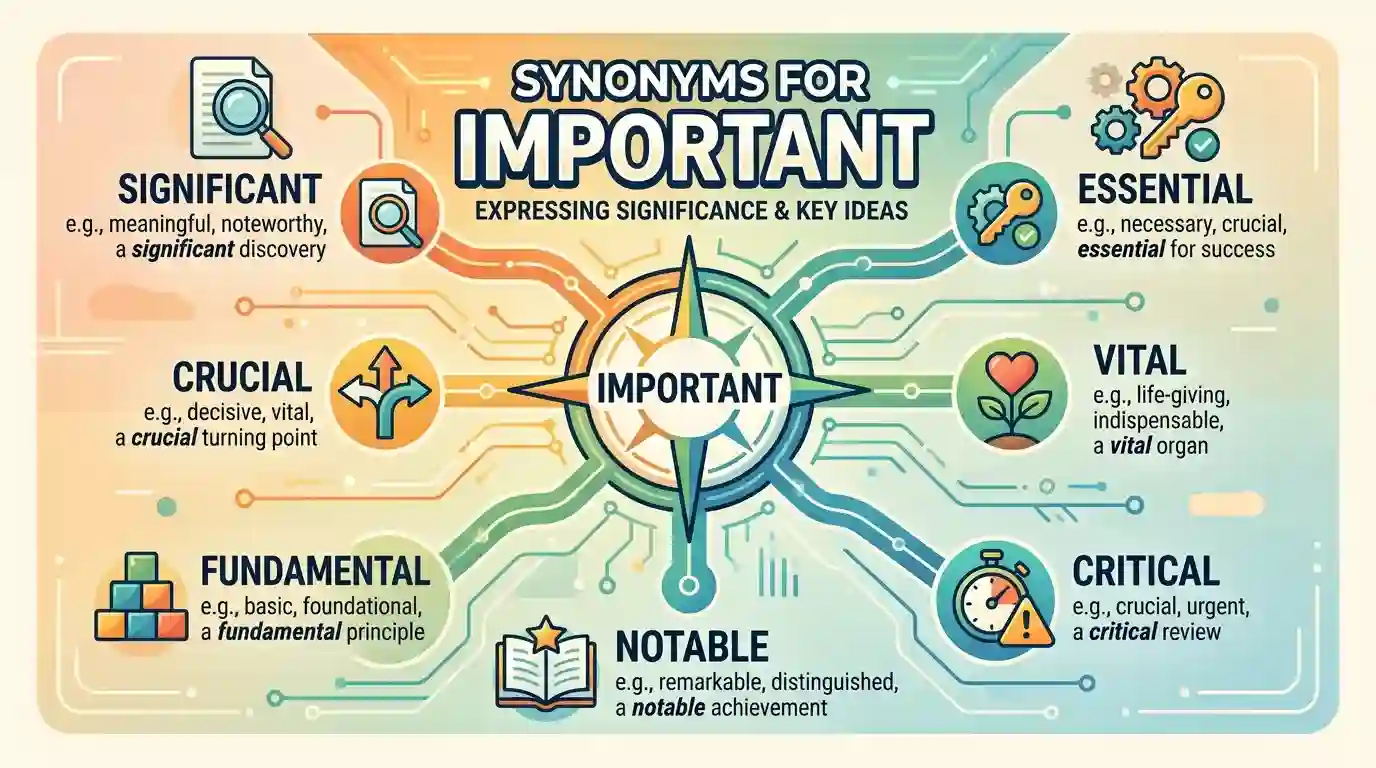
The best synonym for important depends on the context. Common alternatives include significant, essential, crucial, vital, meaningful, valuable, major, and critical. Use significant for something that matters, essential for something necessary, and crucial for something that can strongly affect an outcome.
Key Takeaways
- Significant works well when something has meaning, value, or a noticeable effect.
- Essential, crucial, and vital express a stronger sense of importance or necessity.
- Meaningful and valuable are useful when discussing personal worth or benefits.
- Key, major, and principal help identify the main part of a subject.
- Choose a synonym based on its exact meaning, not simply because it sounds more impressive.
What Does Important Mean?
The word important is an adjective that describes something with considerable value, meaning, influence, or effect. It can refer to a major decision, an essential task, a meaningful relationship, or a person who has influence.
For example:
- Decision: We need to make an important decision today.
- Work: Meeting the deadline is important to our team.
- Relationships: Family is important to me.
- Education: Reading is an important skill for students.
According to Cambridge Dictionary, important can describe something necessary or valuable, as well as something that has a great effect or influence.
English meaning – Cambridge Dictionary
+1
Because the word has several uses, no single replacement works in every sentence. The best choice communicates exactly why something matters.
30 Synonyms for Important and Their Meanings
Here are 30 useful alternatives, grouped by meaning and writing style. The examples show how to use each word naturally.
Common Synonyms for Important
| Synonym | Meaning | Example |
|---|---|---|
| 1. Significant | Having notable meaning or effect | The study found significant changes. |
| 2. Major | Large in scale or importance | She made a major contribution. |
| 3. Valuable | Worth a lot or useful | His feedback was valuable. |
| 4. Meaningful | Having personal or deeper significance | We had a meaningful conversation. |
| 5. Notable | Worth noticing | She achieved notable success. |
| 6. Relevant | Connected to the subject | Include only relevant details. |
| 7. Key | Central to an issue or result | Trust is a key factor. |
| 8. Primary | First in importance | Our primary goal is growth. |
| 9. Principal | Main or leading | Safety is our principal concern. |
| 10. Substantial | Considerable in amount or degree | The project needs substantial funding. |
These words work well in everyday writing, school assignments, workplace communication, and general explanations.
Stronger Synonyms for Important
Use these words when you need to communicate urgency, necessity, or a major effect.
| Synonym | Meaning | Example |
|---|---|---|
| 11. Crucial | Extremely important to success | Sleep is crucial for recovery. |
| 12. Essential | Absolutely necessary | Water is essential for life. |
| 13. Vital | Necessary for life or success | Clear communication is vital. |
| 14. Critical | Extremely important, often at a decisive point | This is a critical stage. |
| 15. Pivotal | Having a major influence on what happens next | Her advice played a pivotal role. |
| 16. Paramount | More important than anything else | Patient safety is paramount. |
| 17. Indispensable | Impossible or very difficult to do without | Experience is indispensable for this role. |
| 18. Consequential | Producing significant results or effects | It was a consequential decision. |
| 19. Momentous | Extremely important because of its lasting impact | They celebrated a momentous occasion. |
| 20. Fundamental | Forming a basic foundation | Honesty is fundamental to trust. |
Usage tip: Essential and indispensable emphasize necessity. Pivotal highlights influence on an outcome, while momentous often describes an event with lasting significance.
Formal and Academic Synonyms
These alternatives can make essays, reports, research summaries, and professional documents more precise.
| Synonym | Best use | Example |
|---|---|---|
| 21. Noteworthy | Something worth attention | The report identifies a noteworthy trend. |
| 22. Influential | Something or someone that affects others | She is an influential researcher. |
| 23. Prominent | Someone or something well-known or noticeable | He is a prominent economist. |
| 24. Substantive | Having real content or significance | The meeting produced substantive changes. |
| 25. Material | Relevant enough to affect a decision | The review identified a material error. |
| 26. Imperative | Absolutely necessary or urgent | Immediate action is imperative. |
| 27. Far-reaching | Having wide or lasting effects | The policy introduced far-reaching reforms. |
| 28. Weighty | Serious and deserving careful thought | They discussed several weighty issues. |
| 29. Meaningful | Having genuine significance | The findings offer meaningful insights. |
| 30. Fundamental | Basic and central to a subject | The paper examines fundamental principles. |
Some words have specialized meanings. For instance, material often refers to information that could affect a decision, particularly in legal, financial, or business settings. Influential describes the ability to affect people or events rather than simply having high value. These distinctions help prevent awkward word choices.
Collins English Thesaurus
+1
Best Synonyms for Important in Different Situations
The right word depends on your audience and purpose. Here are practical replacements for common writing situations.
In Essays and Academic Writing
When writing an essay, avoid repeating important in every paragraph. Choose a more precise alternative based on your argument.
| Instead of | Try | Example |
|---|---|---|
| An important factor | A key factor | Cost is a key factor in the decision. |
| An important finding | A significant finding | The research revealed a significant finding. |
| An important principle | A fundamental principle | Equality is a fundamental principle. |
| An important result | A noteworthy result | The experiment produced a noteworthy result. |
| An important change | A substantial change | The new policy caused a substantial change. |
Do not automatically replace every instance of important. If the original word communicates your meaning clearly, keeping it may be the better choice.
In Business and Professional Emails
Professional writing benefits from words that explain priorities, urgency, and business impact.
- Key: “Please review the key points before the meeting.”
- Critical: “This information is critical to completing the project.”
- Essential: “Your approval is essential before we proceed.”
- Priority: “Resolving the issue is our top priority.”
- Relevant: “Please share any relevant documents.”
For example, instead of writing, “This is a very important email,” you could write, “This email contains information essential to tomorrow’s meeting.”
The revised sentence tells readers why they should pay attention.
In Everyday Conversations
Simple words often sound more natural in casual speech.
- “That’s really important to me.” → “That means a lot to me.”
- “This is an important game.” → “This is a big game.”
- “Your help was important.” → “Your help was valuable.”
- “It’s important to get enough sleep.” → “Getting enough sleep is essential.”
- “She is an important person in my life.” → “She means a lot to me.”
Remember that means a lot to me is a phrase rather than a direct one-word synonym. However, it can express personal importance more naturally than a formal adjective.
Important vs. Significant vs. Crucial vs. Essential
These four words are closely related, but each emphasizes a different idea.
| Word | Main emphasis | Example |
|---|---|---|
| Important | General value or importance | This is an important meeting. |
| Significant | Meaningful effect or degree | The change was significant. |
| Crucial | A decisive effect on success or failure | Timing is crucial to the plan. |
| Essential | Something necessary | A password is essential for access. |
Consider this example: a deadline may be important because it matters, significant because missing it has serious consequences, crucial because it determines whether a project succeeds, and essential because meeting it is required.
These differences are not rigid rules. The words can overlap, but choosing the most precise one makes your writing clearer.
How to Replace “Very Important” With Stronger Words
The phrase very important is correct, but it can become repetitive. You can often replace it with a single word that communicates a clearer meaning.
| Original phrase | Better alternative |
|---|---|
| Very important decision | Crucial decision |
| Very important requirement | Essential requirement |
| Very important role | Pivotal role |
| Very important issue | Critical issue |
| Very important event | Momentous event |
| Very important goal | Primary goal |
| Very important information | Key information |
| Very important resource | Vital resource |
Choose the replacement according to the situation. A momentous event has major significance, while a critical issue may require urgent attention. They are not interchangeable in every sentence.
A Quick Test Before Choosing a Synonym
Ask yourself three questions:
- Does the subject have great value or meaning? Try significant or valuable.
- Is it necessary for something to happen? Try essential, vital, or indispensable.
- Can it strongly influence an outcome? Try crucial, pivotal, or consequential.
This simple test helps you choose words for meaning rather than variety alone.
Frequently Asked Questions
What is the best synonym for important?
Significant is a versatile choice when something has considerable meaning or effect. However, essential is better for something necessary, crucial for something decisive, and valuable for something useful or worthwhile.
What is another word for very important?
Common alternatives include crucial, essential, vital, critical, paramount, and pivotal. Use crucial when success depends on something, essential when it is required, and paramount when it takes priority over everything else.
What is a formal word for important?
Formal alternatives include significant, consequential, fundamental, paramount, substantive, and noteworthy. The best choice depends on the sentence. For example, consequential emphasizes effects, while fundamental describes something basic to a subject.
What is a stronger word than important?
Crucial, vital, paramount, and indispensable can express stronger meanings than important. Choose indispensable when something cannot reasonably be done without it, or paramount when it ranks above other concerns.
What can I use instead of important in an essay?
For academic writing, consider significant, fundamental, key, substantial, noteworthy, and consequential. Use significant for meaningful findings, fundamental for core principles, and consequential for decisions or events with major effects.
Are important and significant the same?
They overlap, but they are not always identical. Important is a broad term for something that matters. Significant often emphasizes a meaningful effect, difference, or level of importance. In research, statistically significant also has a specific technical meaning.
Conclusion
The best synonym for important is the word that expresses your intended meaning most clearly. Use significant for meaningful effects, essential for necessity, crucial for decisive situations, valuable for usefulness, and pivotal for something that changes an outcome.
Instead of replacing important with the same alternative every time, consider the sentence, audience, and purpose. A precise word makes your writing clearer, more natural, and more effective.

I am Abubakar, an educator and content writer with a Master’s degree in English Language. I write about English language, vocabulary, and educational topics, simplifying complex concepts for everyday readers. Alongside my passion for teaching and learning, I focus on creating helpful and engaging content that improves knowledge, communication skills, and language understanding.