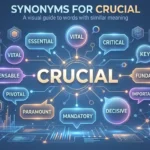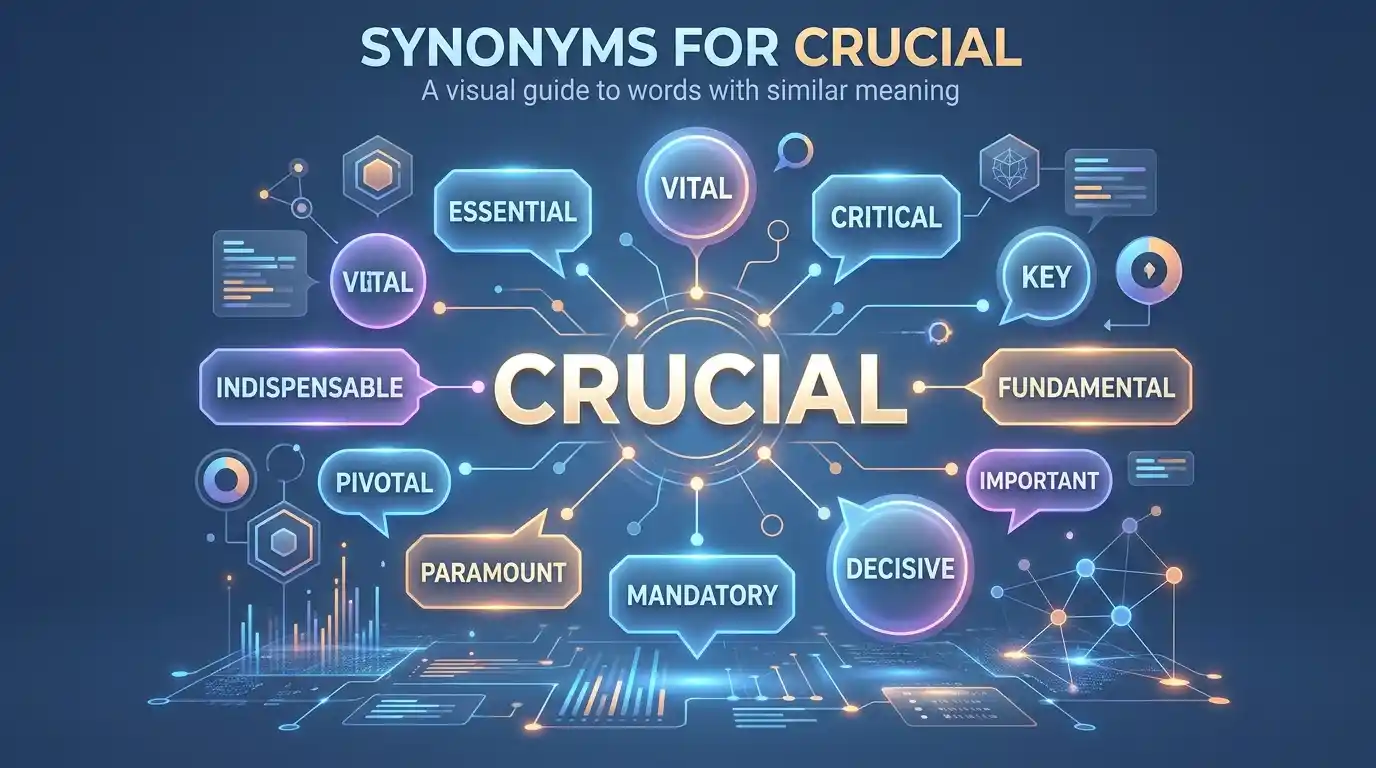
A synonym for crucial is essential, which means extremely important or necessary. Other common synonyms include vital, critical, important, decisive, pivotal, and indispensable. The best alternative depends on the sentence. Use essential for something necessary, decisive for something that determines an outcome, and urgent when a matter needs immediate attention.
Key Takeaways
- Essential is one of the closest synonyms for crucial.
- Vital emphasizes the importance of something for success or survival.
- Critical highlights a serious situation or an important point.
- Decisive describes something that determines an outcome.
- Choose a synonym based on the meaning and tone of your sentence.
What Does Crucial Mean?
The word crucial is an adjective that describes something extremely important because other things may depend on it. A crucial decision, for example, can influence what happens next. A crucial detail may help someone understand a problem or reach the correct conclusion.
According to Cambridge Dictionary and Oxford Learner’s Dictionaries, crucial commonly describes something extremely important or necessary, especially when it affects an outcome.
English meaning – Cambridge Dictionary
+1
Crucial meaning and pronunciation
- Pronunciation: KROO-shuhl
- Part of speech: Adjective
- Simple definition: Extremely important or necessary
- Common usage: A crucial decision, a crucial step, a crucial role, or a crucial factor.
Examples:
- Regular practice is crucial to improving your English.
- Clear communication plays a crucial role in teamwork.
- Saving money was crucial to reaching her financial goal.
In each sentence, crucial explains why something matters. Replacing it with another word can change the emphasis slightly, so it helps to understand the alternatives before choosing one.
15 Best Synonyms for Crucial
The following words are useful alternatives to crucial. Each has a slightly different meaning or emphasis.
| Synonym | Meaning | Example sentence |
|---|---|---|
| 1. Essential | Absolutely necessary | Sleep is essential for good health. |
| 2. Vital | Extremely important for success or survival | Clean water is vital to human life. |
| 3. Critical | Extremely important, often in a serious situation | Timing is critical to the operation. |
| 4. Important | Having great value or significance | Education is important for personal growth. |
| 5. Decisive | Determining the final result | Her final argument was decisive. |
| 6. Pivotal | Playing a central role in a major change | That meeting was pivotal to the project. |
| 7. Indispensable | So necessary that it is difficult to do without | Her experience proved indispensable. |
| 8. Significant | Having considerable importance or meaning | The discovery was significant. |
| 9. Fundamental | Forming a necessary foundation | Trust is fundamental to a healthy relationship. |
| 10. Key | Particularly important to success | Planning is a key part of the process. |
| 11. Necessary | Needed for a purpose | A valid ID is necessary for entry. |
| 12. Momentous | Very important because of its lasting effects | They made a momentous decision. |
| 13. Central | At the heart of an issue or activity | Safety is central to the discussion. |
| 14. Pressing | Requiring prompt attention | Housing has become a pressing concern. |
| 15. Urgent | Requiring immediate attention or action | The team received an urgent request. |
These words overlap with crucial, but they are not interchangeable in every situation. Dictionary and thesaurus references support many of these alternatives, while their example sentences illustrate practical differences in usage.
Cambridge English
+2
Synonyms for Importance and Necessity
Use these words when explaining why something matters or why it cannot easily be left out.
- Essential: Best when something is necessary for a particular purpose. Example: “Accurate information is essential for good research.”
- Vital: Best when something strongly affects success, health, or survival. Example: “Teamwork is vital to completing the project.”
- Indispensable: Best when something is so useful or necessary that it is difficult to manage without it. Example: “Her guidance was indispensable during training.”
- Fundamental: Best when something forms the basic foundation of a system, idea, or relationship. Example: “Reading is a fundamental skill.”
- Necessary: Best for a straightforward statement about what is required. Example: “A password is necessary to access the account.”
These options work well in academic writing, workplace communication, and everyday conversation. For example, essential sounds direct and practical, while indispensable places more emphasis on how difficult something would be to do without.
Synonyms for Decisions and Outcomes
Some synonyms are especially useful when an action, event, or choice influences what happens next.
- Decisive: Use it when something determines the result. Example: “Her final goal was decisive in the match.”
- Pivotal: Use it when something plays a central role in a major change. Example: “The new partnership was pivotal to the company’s growth.”
- Critical: Use it when an important point, action, or condition needs close attention. Example: “The next phase is critical to the project’s success.”
- Momentous: Use it for an event or decision with major or lasting consequences. Example: “The election was a momentous occasion.”
- Central: Use it when something lies at the heart of an issue. Example: “Customer satisfaction is central to our strategy.”
Remember that decisive is more specific than important. A crucial event may influence the result, but a decisive event helps determine it.
Synonyms for Formal and Urgent Situations
Some alternatives fit formal writing or situations that require quick action.
- Significant: Appropriate for findings, changes, events, and results. Example: “The study revealed a significant difference.”
- Pressing: Appropriate for problems that need attention soon. Example: “The organization must address a pressing concern.”
- Urgent: Appropriate when immediate action is needed. Example: “Please respond to this urgent message.”
- Key: A simple, natural option for business and everyday writing. Example: “Communication is a key factor in success.”
- Important: A versatile choice that works in nearly any setting. Example: “This is an important part of the application.”
Use urgent when time matters, not simply when something has great value. A long-term education plan can be crucial without being urgent, while a minor technical issue may be urgent if it needs immediate repair.
Crucial vs. Critical vs. Essential vs. Vital
These four words are close in meaning, but each places emphasis on a different aspect of importance.
| Word | Main emphasis | Best example |
|---|---|---|
| Crucial | Importance to an outcome | This decision is crucial to our future. |
| Critical | Seriousness or importance at a key point | The patient needs critical care. |
| Essential | Necessity | Water is essential for life. |
| Vital | Importance to success or survival | Accurate data is vital to the research. |
Oxford Learner’s Dictionaries also distinguishes these terms by their typical emphasis: essential focuses on necessity, vital stresses importance to success or existence, and decisive highlights the ability to determine an outcome.
Oxford Learner’s Dictionaries
+1
Which word should you choose?
Use crucial when an outcome depends heavily on something. Choose essential when it is required. Choose critical when the situation is serious or a key stage needs attention. Use vital when you want to emphasize how strongly something affects success or survival.
How to Use Crucial Synonyms in Sentences
Replacing crucial is easiest when you keep the original meaning in mind. Here are practical examples for different situations.
1. Academic writing
Original: “Research is crucial for understanding the topic.”
Alternative: “Research is essential for understanding the topic.”
Why it works: Essential clearly expresses the need for research.
2. Business writing
Original: “Customer feedback is crucial to our success.”
Alternative: “Customer feedback is vital to our success.”
Why it works: Vital emphasizes how much success depends on feedback.
3. Everyday conversation
Original: “Getting enough sleep is crucial before the exam.”
Alternative: “Getting enough sleep is important before the exam.”
Why it works: Important sounds natural and less formal.
4. Decision-making
Original: “Her recommendation was crucial to the final decision.”
Alternative: “Her recommendation was decisive in the final decision.”
Why it works: Decisive emphasizes the recommendation’s influence on the outcome. The wording changes slightly, so this version is best when her recommendation actually determined the decision.
5. Formal reports
Original: “The findings are crucial to the investigation.”
Alternative: “The findings are significant to the investigation.”
Why it works: Significant highlights the importance of the findings. However, use essential if the investigation cannot proceed without them.
Common Mistakes When Choosing a Synonym
Even words with similar definitions can create awkward or inaccurate sentences. Avoid these common mistakes.
1. Treating every synonym as identical.
Essential means necessary, while decisive means determining an outcome. Use the word that expresses your intended meaning.
2. Using urgent when you mean important.
Incorrect for many contexts: “Learning grammar is urgent for long-term success.”
Better: “Learning grammar is important for long-term success.”
Use urgent when something needs prompt attention.
3. Using momentous for minor matters.
Momentous usually describes events or decisions with major consequences. It would sound exaggerated when describing a routine office task.
4. Overusing strong adjectives.
Words such as vital, indispensable, and momentous can sound dramatic when used too often. In simple sentences, important may communicate the message more naturally.
5. Ignoring grammar when replacing a word.
Some words fit different sentence patterns. For example, “This step is crucial to success” can become “This step is essential for success.” When you change a word, check the surrounding prepositions and sentence structure.
Frequently Asked Questions
What is the best synonym for crucial?
Essential is one of the closest synonyms for crucial. Both describe something extremely important or necessary. However, critical may work better for a serious situation, while decisive is more precise when an action determines an outcome.
What is another word for crucial in a sentence?
Depending on the context, you can use essential, vital, critical, important, pivotal, or key. For example, “Practice is crucial for improvement” can become “Practice is essential for improvement” or “Practice is key to improvement.”
Does crucial mean important?
Yes. Crucial means extremely important, especially when something affects a result or when other things depend on it. It generally expresses stronger importance than the everyday word important. For example, a crucial decision may influence the success of an entire project.
What is a stronger word for crucial?
There is no single stronger word in every context. Indispensable emphasizes that something cannot easily be done without it, while vital stresses its importance to success or survival. Momentous describes an event or decision with major consequences.
What is the opposite of crucial?
Common antonyms include unimportant, insignificant, minor, trivial, and unnecessary. For example, “This is a crucial detail” can become “This is an insignificant detail” if the detail has little effect on the result. Choose an antonym based on whether you mean low importance or lack of necessity.
Is crucial a formal word?
Yes. Crucial is suitable for academic writing, professional reports, business communication, and everyday conversation. It is not limited to formal situations. Words such as essential, vital, and critical are also common in professional English.
Final Thoughts
The best synonym for crucial depends on what you want to express. Essential is an excellent general alternative when something is necessary. Use vital to stress success or survival, critical for serious situations, decisive for outcomes, and pivotal for major changes.
Before replacing crucial, consider the sentence’s purpose and tone. The right word will make your writing more precise, natural, and effective.

I am Rana Fareed, an educator and content writer with an MPhil in Business Administration and an LLB (Law) degree. I write on current affairs, English language topics, and synonyms, simplifying complex ideas for everyday readers. Alongside teaching, I am passionate about helping people improve their knowledge and communication skills.