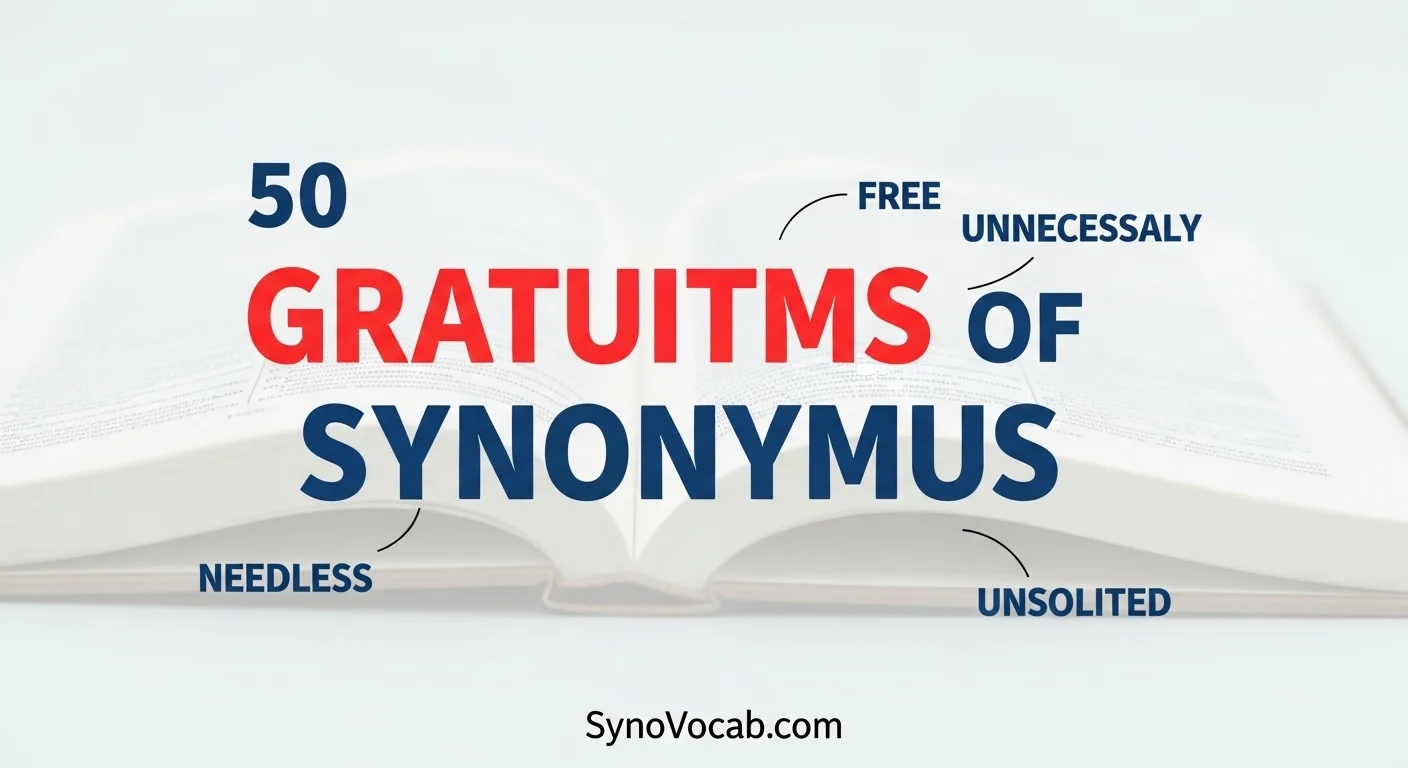
Have you ever received something you did not ask for? Or seen a comment that felt unnecessary? That is where the word gratuitous often fits.
Gratuitous means something is given for free, or something is done without a good reason. For example, “He made a gratuitous comment during the meeting.” It means the comment was not needed.
Learning synonyms of gratuitous helps students write better essays. Bloggers and content writers can avoid repeating the same word. Daily English users can speak more clearly and confidently.
In this guide, you will learn 50 simple synonyms of gratuitous with easy meanings and examples.
Free
Meaning: Given without asking for money.
Examples:
- The shop gave me a free sample.
- She got a free ticket to the show.
Complimentary
Meaning: Given as a gift or without cost.
Examples:
- We received complimentary drinks.
- The hotel offered complimentary breakfast.
Unnecessary
Meaning: Not needed at all.
Examples:
- His joke was unnecessary.
- Do not add unnecessary words.
Unwarranted
Meaning: Not right or not deserved.
Examples:
- That was an unwarranted attack.
- Her anger felt unwarranted.
Uncalled-for
Meaning: Not polite or not needed.
Examples:
- His rude remark was uncalled-for.
- That reaction was uncalled-for.
Needless
Meaning: Not needed.
Examples:
- It was a needless fight.
- Do not take needless stress.
Extra
Meaning: More than needed.
Examples:
- She added extra sugar.
- That step is extra work.
Redundant
Meaning: Repeating what is already said.
Examples:
- That line sounds redundant.
- Avoid redundant phrases.
Superfluous
Meaning: More than what is needed.
Examples:
- The extra detail was superfluous.
- Remove superfluous words.
Excessive
Meaning: Too much.
Examples:
- He used excessive force.
- The price increase is excessive.
Overdone
Meaning: Done too much.
Examples:
- The joke is overdone.
- The makeup looks overdone.
Pointless
Meaning: Having no reason.
Examples:
- It was a pointless argument.
- This meeting feels pointless.
Baseless
Meaning: Without proof or reason.
Examples:
- The rumor is baseless.
- His claim was baseless.
Groundless
Meaning: Without any reason.
Examples:
- Her fear was groundless.
- That complaint is groundless.
Unjustified
Meaning: Not fair or not right.
Examples:
- The anger was unjustified.
- That action seems unjustified.
Arbitrary
Meaning: Done without clear reason.
Examples:
- It was an arbitrary rule.
- The choice felt arbitrary.
Spontaneous
Meaning: Done without planning.
Examples:
- We took a spontaneous trip.
- She made a spontaneous speech.
Unprovoked
Meaning: Done without cause.
Examples:
- It was an unprovoked attack.
- He shouted in an unprovoked way.
Reckless
Meaning: Done without care.
Examples:
- He made a reckless move.
- That was reckless driving.
Lavish
Meaning: Given in large amount.
Examples:
- They threw a lavish party.
- She gave lavish praise.
Generous
Meaning: Happy to give freely.
Examples:
- He is very generous.
- She gave a generous gift.
Costless
Meaning: Without cost.
Examples:
- The service is costless.
- Advice can be costless.
Gratis
Meaning: Given for free.
Examples:
- I got the book gratis.
- They offered snacks gratis.
Freely Given
Meaning: Given without force.
Examples:
- Help was freely given.
- She freely gave advice.
Voluntary
Meaning: Done by choice.
Examples:
- It was voluntary work.
- He made a voluntary donation.
Uninvited
Meaning: Not asked to come.
Examples:
- He came uninvited.
- That advice was uninvited.
Random
Meaning: Without clear plan.
Examples:
- It was a random choice.
- She asked a random question.
Senseless
Meaning: Without sense or reason.
Examples:
- It was a senseless crime.
- The fight was senseless.
Futile
Meaning: Having no result.
Examples:
- The effort was futile.
- It is futile to argue.
Aimless
Meaning: Without clear goal.
Examples:
- He walked in an aimless way.
- The talk felt aimless.
Impulsive
Meaning: Done quickly without thinking.
Examples:
- It was an impulsive buy.
- She made an impulsive choice.
Unplanned
Meaning: Not planned before.
Examples:
- It was an unplanned visit.
- The stop was unplanned.
Surplus
Meaning: More than needed.
Examples:
- There is a surplus of food.
- They sold surplus items.
Overflowing
Meaning: More than it can hold.
Examples:
- The cup is overflowing.
- The room was overflowing with people.
Extravagant
Meaning: Spending too much.
Examples:
- It was an extravagant gift.
- She made an extravagant purchase.
Unrequired
Meaning: Not required.
Examples:
- That step is unrequired.
- The form has unrequired fields.
Free-of-Charge
Meaning: Without payment.
Examples:
- The repair was free-of-charge.
- Samples are free-of-charge.
Donation-Based
Meaning: Paid by choice.
Examples:
- The class is donation-based.
- The event was donation-based.
Unsolicited
Meaning: Not asked for.
Examples:
- He gave unsolicited advice.
- She received unsolicited emails.
Offhand
Meaning: Said without thinking.
Examples:
- He made an offhand comment.
- That was an offhand remark.
Casual
Meaning: Done without much care.
Examples:
- It was a casual comment.
- She wore casual clothes.
Loose
Meaning: Not strict or tight.
Examples:
- He made a loose claim.
- The rules feel loose.
Unnecessary Added
Meaning: Added without need.
Examples:
- That detail is unnecessary added.
- Remove unnecessary added words.
Unmerited
Meaning: Not deserved.
Examples:
- He faced unmerited blame.
- That praise was unmerited.
Unasked
Meaning: Not requested.
Examples:
- She gave unasked advice.
- He shared unasked opinions.
Without Cause
Meaning: Done for no reason.
Examples:
- He laughed without cause.
- She cried without cause.
Without Reason
Meaning: No clear reason.
Examples:
- He left without reason.
- She shouted without reason.
Over-the-Top
Meaning: Too much or too dramatic.
Examples:
- The reaction was over-the-top.
- His speech was over-the-top.
Extra Added
Meaning: Added more than needed.
Examples:
- That sugar is extra added.
- Remove extra added lines.
Spare
Meaning: Extra and not needed now.
Examples:
- Do you have a spare pen?
- There is spare time today.
Conclusion
Learning synonyms of gratuitous makes your writing stronger and clearer. You avoid repeating the same word again and again. Students write better essays. Bloggers create fresh content. Speakers sound more confident.
Start using these words in emails, essays, and daily talks. Practice a few each day. Soon, your English will feel natural and powerful.

I am Rana Fareed, an educator and content writer with an MPhil in Business Administration and an LLB (Law) degree. I write on current affairs, English language topics, and synonyms, simplifying complex ideas for everyday readers. Alongside teaching, I am passionate about helping people improve their knowledge and communication skills.