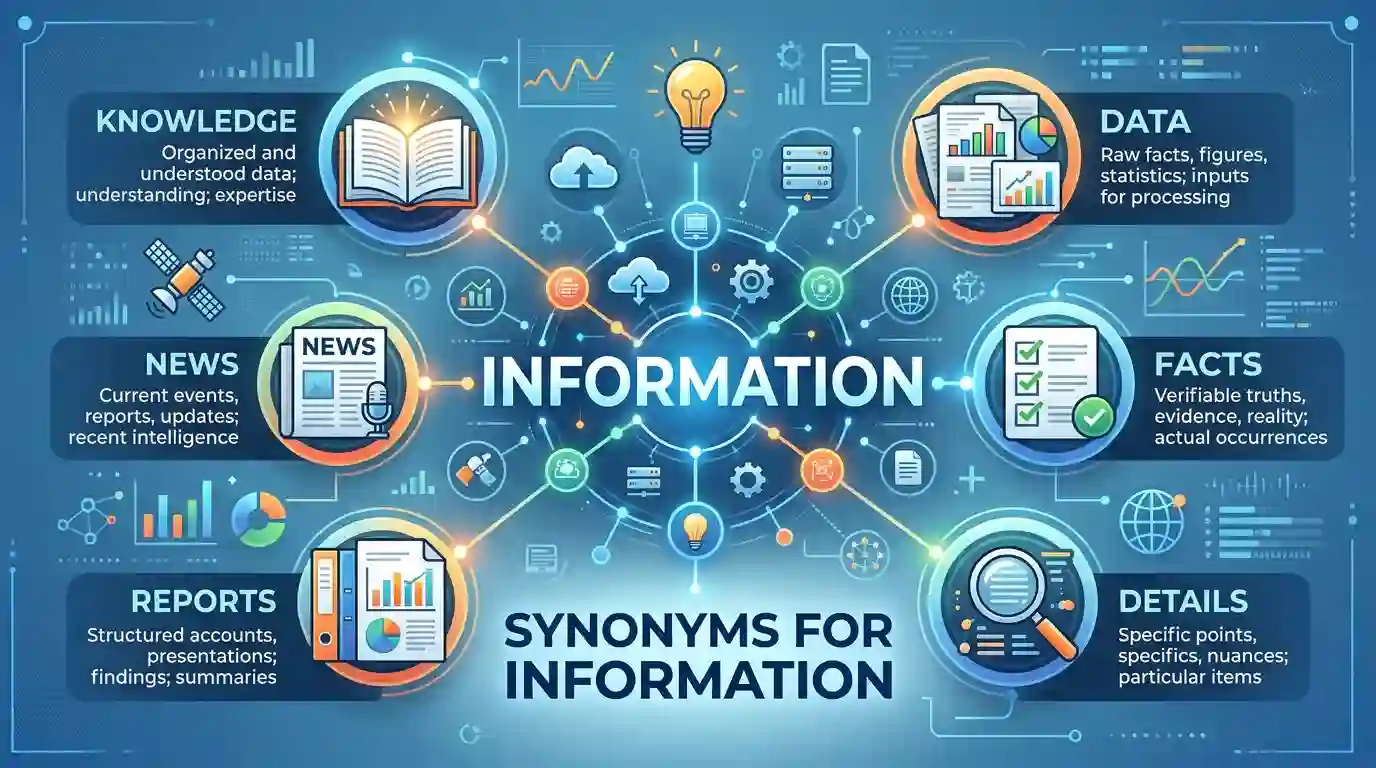
A synonym for information is data, facts, details, knowledge, or news. The best alternative depends on the context. Use facts for statements that are true, data for collected figures or observations, details for specific points, knowledge for understanding gained through learning, and news for recent events or developments.
Key Takeaways
- Facts, details, and data are useful alternatives, but they have different meanings.
- Knowledge emphasizes what a person understands or has learned.
- News refers to new information about events or developments.
- Evidence supports a claim, while findings often describe the results of research.
- Choose a synonym that preserves the original meaning of your sentence.
What Does Information Mean?
Information means facts, details, or knowledge about a person, place, event, subject, or situation. It helps someone understand something or make a decision.
For example, a school website may provide information about admission dates, tuition fees, and class schedules. A doctor may explain information about a treatment, while a business may share information about its services.
The word is a noun and is generally uncountable in English. You would usually say some information, more information, or a piece of information, rather than informations.
English meaning – Cambridge Dictionary
+1
The word you choose as a replacement depends on what kind of information you mean. A collection of measurements may be called data, while a message about a recent event may be called news.
25 Synonyms for Information and Their Meanings
Here are 25 useful alternatives, with explanations and examples to help you choose the right word.
| Synonym | Meaning or best use | Example |
|---|---|---|
| 1. Facts | Statements that are true | Check the facts before publishing. |
| 2. Details | Specific pieces of information | Please send the details by email. |
| 3. Data | Collected facts, figures, or observations | The team analyzed the data. |
| 4. Knowledge | Understanding gained through learning or experience | Her knowledge of history is impressive. |
| 5. News | Information about recent events | I have good news for you. |
| 6. Evidence | Information that supports or challenges a claim | The evidence supports the conclusion. |
| 7. Findings | Results discovered through research or investigation | The findings were published yesterday. |
| 8. Report | An organized account of facts or events | Read the report before the meeting. |
| 9. Account | A description of an event or situation | He gave an account of what happened. |
| 10. Intelligence | Information gathered for analysis or decision-making | Officials reviewed the intelligence. |
| 11. Material | Content used for study, reference, or discussion | The library has useful study material. |
| 12. Records | Documents or stored details | We checked the payment records. |
| 13. Documentation | Documents that explain or verify something | Keep the documentation for your files. |
| 14. Particulars | Specific facts about something | She requested the particulars of the offer. |
| 15. Message | Information communicated to someone | I received your message. |
| 16. Update | New or revised information | The manager shared an update. |
| 17. Announcement | Information made known publicly | The school issued an announcement. |
| 18. Briefing | A short, organized explanation | Staff attended the morning briefing. |
| 19. Notification | A message that informs someone of something | I received a notification about the appointment. |
| 20. Guidance | Information that helps someone decide what to do | The guide provides guidance for beginners. |
| 21. Instructions | Information explaining how to do something | Follow the instructions carefully. |
| 22. Directions | Information explaining a route or procedure | The directions led us to the office. |
| 23. Guidelines | Recommended rules or principles | Review the safety guidelines. |
| 24. Insight | A useful or deeper understanding | The interview offered insight into the problem. |
| 25. Intelligence report | An organized account of gathered intelligence | The agency reviewed the intelligence report. |
These alternatives are related to information, but they are not interchangeable in every sentence. For example, guidance suggests help with a decision, while documentation refers to supporting documents. Use the word that expresses your intended meaning most clearly.
Cambridge English
+2
Which Synonym for Information Should You Use?
The easiest way to find the right synonym is to consider what the information does.
For Everyday Conversations
Choose simple words that sound natural when speaking with friends, family, or coworkers.
- Details: “Can you give me more details about the trip?”
- News: “Do you have any news about the job?”
- Facts: “Let’s look at the facts before deciding.”
- Update: “Please send me an update when you arrive.”
- Message: “I left a message for the teacher.”
For example, instead of saying, “Can you give me information about the event?” you could say, “Can you give me the details about the event?”
Both sentences are correct. Details sounds more specific because it suggests practical points such as the date, location, and schedule.
For Academic and Professional Writing
In essays, business reports, presentations, and professional emails, the best alternative depends on the type of content.
- Data: Use it for measurements, figures, survey results, or collected observations.
- Findings: Use it for results produced by research or investigation.
- Documentation: Use it for supporting records and explanatory documents.
- Evidence: Use it when information supports a conclusion or claim.
- Report: Use it for an organized description of events, results, or activities.
- Knowledge: Use it when discussing understanding of a subject.
For example:
Original: “The information shows that customer satisfaction improved.”
More precise: “The survey data show that customer satisfaction improved.”
The second sentence is appropriate if the information consists of survey results. However, if the source is a written summary rather than a dataset, report or findings may be more accurate.
For Research and Evidence
Research writing requires extra care because related words can express different levels of certainty.
- Evidence refers to information that supports or challenges a claim.
- Findings refers to results obtained through a study or investigation.
- Data refers to observations or measurements that can be analyzed.
- Sources refers to the books, articles, documents, or people from which information comes.
- Facts refers to things that are true, rather than merely suspected or reported.
For example, “The researcher collected information from 200 survey responses” could become “The researcher collected data from 200 survey responses.”
But “The information supports the theory” should not automatically become “The evidence proves the theory.” Evidence may support a claim without proving it conclusively.
Information vs. Data vs. Knowledge
These three words are closely related, but each emphasizes something different.
| Word | Main emphasis | Example |
|---|---|---|
| Information | Facts or details about a subject | The website provides information about college programs. |
| Data | Collected observations, measurements, or figures | The researcher analyzed enrollment data. |
| Knowledge | Understanding gained through learning or experience | Her knowledge helped the team solve the problem. |
Think of a student researching climate change. Temperature readings are data. A summary explaining changes in temperatures is information. Understanding what those changes may mean is part of the student’s knowledge.
This is a helpful general distinction, not a rigid rule. In everyday English, the meanings can overlap. A dictionary, textbook, or research paper may also use these words in more specialized ways.
Examples of Information Synonyms in Sentences
Seeing synonyms in context makes it easier to understand when to use each word. Here are examples for school, work, research, and everyday communication.
| Original sentence | Improved alternative | Why it works |
|---|---|---|
| I need information about the course. | I need details about the course. | Focuses on specific course facts. |
| The company collected information from customers. | The company collected data from customers. | Works when referring to recorded responses or measurements. |
| The article provides information about the event. | The article provides an account of the event. | Emphasizes a description of what happened. |
| The information supports the argument. | The evidence supports the argument. | Highlights support for a claim. |
| She shared information about the new policy. | She shared an update about the new policy. | Suggests newly available information. |
| He has a lot of information about computers. | He has extensive knowledge of computers. | Emphasizes understanding of the subject. |
| The teacher gave us information on the assignment. | The teacher gave us instructions for the assignment. | Works when explaining what students should do. |
Notice that some replacements slightly change the meaning. The goal is not simply to remove the word information. It is to make the sentence more precise.
Common Mistakes When Choosing a Synonym
Even a correct synonym can make a sentence confusing if it does not match the context.
1. Using data when you mean instructions
Incorrect for most contexts: “The teacher gave me data on how to complete the project.”
Better: “The teacher gave me instructions on how to complete the project.”
Data usually refers to collected observations, figures, or similar material, not step-by-step guidance.
2. Using knowledge when you mean recent news
Less natural: “I received knowledge about the school closing.”
Better: “I received news that the school was closing.”
Knowledge emphasizes understanding, while news is suitable for newly reported events.
3. Using evidence for unverified claims
Do not call every statement evidence. A claim may be information, but it becomes useful evidence only when it is relevant to the question being investigated.
4. Treating all synonyms as exact replacements
Report, announcement, briefing, and notification can all communicate information, but each describes a different form or purpose of communication.
5. Using “informations” as the plural
In standard English, information is an uncountable noun. Use “pieces of information” or “items of information” when you need to count individual points.
Frequently Asked Questions
What is the closest synonym for information?
Details and facts are useful close synonyms in many everyday situations. However, the best choice depends on the sentence. Use data for collected observations, knowledge for understanding, and news for recent developments.
What is a more formal word for information?
Depending on the context, formal alternatives include documentation, evidence, findings, data, and intelligence. For example, a research paper might discuss its findings, while a business report might refer to supporting documentation. No single formal alternative works in every situation.
What is a simple word for information?
Facts is a simple, familiar alternative. Details and news are also useful when they fit the meaning. For example, “Please give me more information about the meeting” can become “Please give me more details about the meeting.”
Is knowledge a synonym for information?
Yes, knowledge can be a synonym for information in some contexts, but the meanings are not identical. Information consists of facts or details that someone receives or discovers. Knowledge generally refers to what someone has learned, understood, or gained through experience.
What is another word for useful information?
Useful alternatives include insight, guidance, findings, evidence, and details. Choose insight for a deeper understanding, guidance for help with a decision, and evidence for information that supports a claim.
Is information singular or plural?
Information is an uncountable noun in standard English, so it generally takes a singular verb. Write “The information is helpful,” not “The information are helpful.” To refer to individual items, use “a piece of information” or “several pieces of information.”
English meaning – Cambridge Dictionary
+1
Conclusion
The best answer to “What is a synonym for information?” depends on what you want to communicate. Facts, details, data, knowledge, and news are among the most useful alternatives, while evidence, findings, and documentation work well in more specific contexts.
Before replacing information, consider whether you mean specific facts, collected figures, new developments, supporting evidence, or a person’s understanding. Choosing the right word makes your writing clearer, more natural, and more precise.

I am Abubakar, an educator and content writer with a Master’s degree in English Language. I write about English language, vocabulary, and educational topics, simplifying complex concepts for everyday readers. Alongside my passion for teaching and learning, I focus on creating helpful and engaging content that improves knowledge, communication skills, and language understanding.