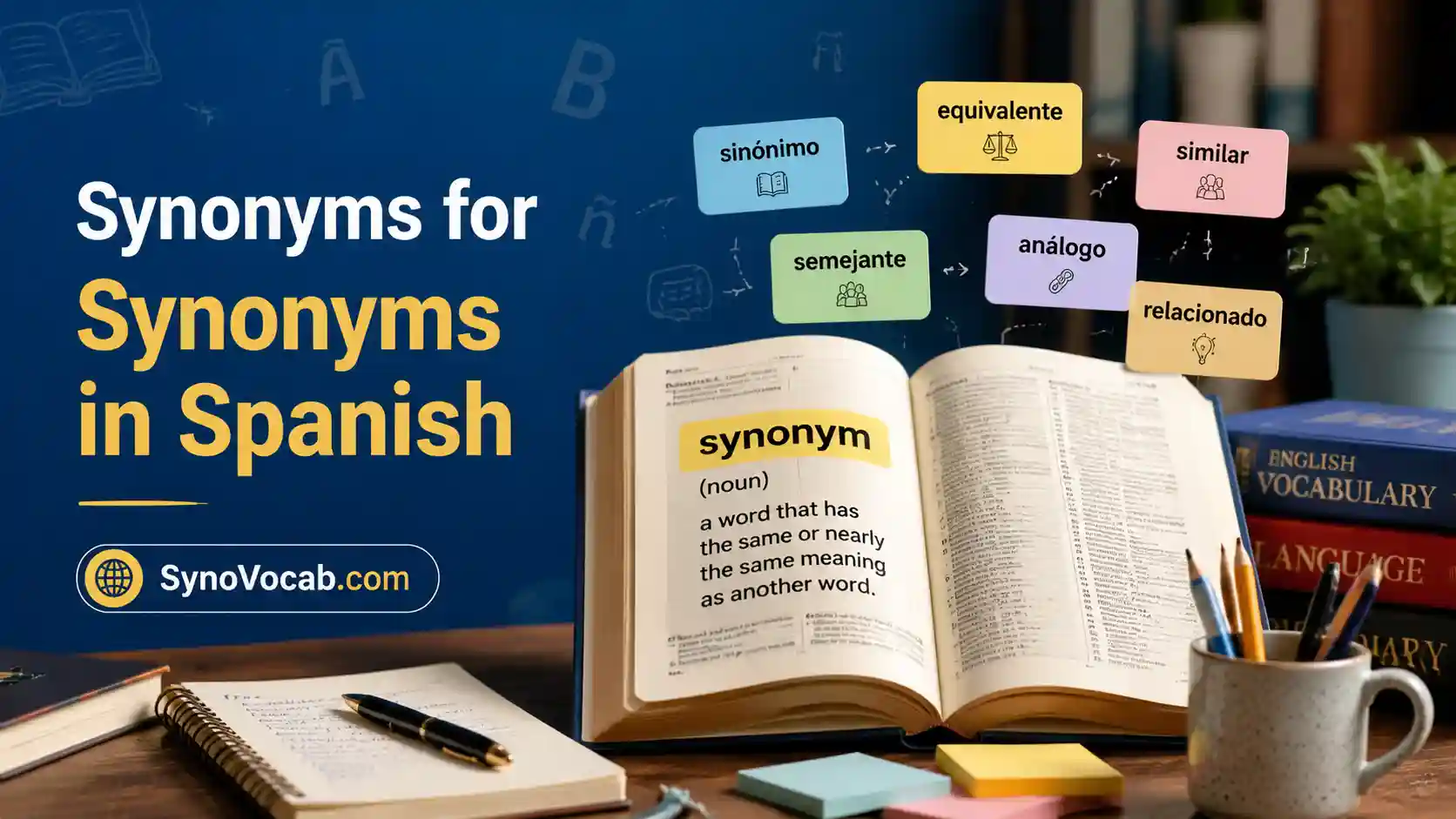
Quick answer: “Synonyms in Spanish” refers to words with similar or identical meanings in the Spanish language, known as sinónimos.
Finding the right synonym can make your Spanish writing clearer, more expressive, and less repetitive. A simple example is replacing bonito with hermoso or bello.
The phrase “synonyms in Spanish” describes alternative words that can be used instead of another word while keeping a similar meaning. These alternatives help speakers choose more precise vocabulary.
Learning Spanish synonyms is useful for students, writers, bloggers, and language learners because it improves communication, strengthens vocabulary, and helps create more natural sentences.
What Does Synonyms in Spanish Mean?
“Synonyms in Spanish” means words in the Spanish language that share similar meanings with other words. These words are called sinónimos and allow people to express ideas in different ways.
Synonyms may have exactly the same meaning in some situations, while others only work in specific contexts. Choosing the correct word depends on tone, location, and the message being communicated.
Examples:
- Feliz and contento can both describe happiness.
- Grande and enorme both describe size, but enorme suggests something much larger.
- Hablar and conversar both relate to speaking, but they may be used differently.
Best Synonyms for Synonyms in Spanish
Spanish has thousands of words that can replace or relate to other vocabulary choices. Some alternatives describe direct word similarity, while others refer to equivalent expressions or related meanings.
1. Sinónimos
Meaning: Words that have the same or a very similar meaning.
Example: Los sinónimos ayudan a mejorar nuestro vocabulario.
2. Palabras equivalentes
Meaning: Words that express the same idea or concept.
Example: Busqué palabras equivalentes para mejorar mi texto.
3. Palabras similares
Meaning: Words that are close in meaning to another word.
Example: Aprender palabras similares facilita estudiar español.
4. Términos equivalentes
Meaning: Expressions that communicate a comparable meaning.
Example: El diccionario muestra términos equivalentes.
5. Voces semejantes
Meaning: Words that have a similar linguistic meaning.
Example: Las voces semejantes pueden variar según el contexto.
6. Expresiones similares
Meaning: Phrases or expressions with related meanings.
Example: Encontré expresiones similares para mi presentación.
7. Palabras relacionadas
Meaning: Words connected by meaning or usage.
Example: Las palabras relacionadas ayudan a ampliar el aprendizaje.
8. Alternativas lingüísticas
Meaning: Different word choices used to express an idea.
Example: Las alternativas lingüísticas hacen el idioma más rico.
9. Sustitutos léxicos
Meaning: Words that can replace another word in some contexts.
Example: Los sustitutos léxicos evitan repeticiones.
10. Variantes de palabras
Meaning: Different forms or choices with related meanings.
Example: Estudiamos variantes de palabras comunes.
11. Equivalencias
Meaning: Similar meanings between different words.
Example: El ejercicio busca equivalencias entre términos.
12. Correspondencias
Meaning: Words that match another word in meaning.
Example: Encontramos correspondencias entre ambos idiomas.
13. Coincidencias semánticas
Meaning: Similarities in meaning between expressions.
Example: Las coincidencias semánticas ayudan en la traducción.
14. Significados similares
Meaning: Ideas expressed in nearly the same way.
Example: Estas palabras tienen significados similares.
15. Términos parecidos
Meaning: Words that resemble each other in meaning.
Example: El alumno aprendió términos parecidos.
16. Palabras afines
Meaning: Words that share a close relationship in meaning.
Example: Las palabras afines facilitan la comunicación.
17. Conceptos equivalentes
Meaning: Ideas that represent the same concept.
Example: Algunos conceptos equivalentes tienen diferentes formas.
18. Expresiones equivalentes
Meaning: Phrases with the same intended message.
Example: Usamos expresiones equivalentes para sonar natural.
19. Formas alternativas
Meaning: Other ways to express the same thought.
Example: Hay formas alternativas de decir esa frase.
20. Opciones léxicas
Meaning: Vocabulary choices available to a speaker or writer.
Example: El escritor seleccionó mejores opciones léxicas.
21. Recursos lingüísticos
Meaning: Language tools used for better expression.
Example: Los recursos lingüísticos mejoran la escritura.
22. Palabras intercambiables
Meaning: Words that can replace each other in certain cases.
Example: Algunas palabras intercambiables dependen del contexto.
23. Sustituciones
Meaning: Replacements made using another suitable word.
Example: Las sustituciones correctas mejoran el estilo.
24. Reemplazos
Meaning: Words used instead of another expression.
Example: Los reemplazos deben conservar el significado.
25. Modismos equivalentes
Meaning: Expressions with similar meanings in usage.
Example: Aprendimos modismos equivalentes en español.
26. Frases similares
Meaning: Sentences or phrases with close meanings.
Example: Practicamos frases similares en clase.
27. Expresiones afines
Meaning: Expressions connected by meaning.
Example: Las expresiones afines enriquecen el idioma.
28. Léxico relacionado
Meaning: Vocabulary connected to a specific idea.
Example: El léxico relacionado ayuda a comprender temas nuevos.
29. Palabras comparables
Meaning: Words that can be compared because of similar meaning.
Example: Estas palabras comparables tienen pequeños matices.
30. Términos cercanos
Meaning: Terms with meanings that are close together.
Example: Los términos cercanos no siempre son iguales.
31. Relaciones semánticas
Meaning: Connections between words based on meaning.
Example: Estudiamos relaciones semánticas en español.
32. Asociaciones lingüísticas
Meaning: Connections between related words.
Example: Las asociaciones lingüísticas ayudan a memorizar.
33. Palabras alternativas
Meaning: Different words that can express a similar message.
Example: Usó palabras alternativas para evitar repetición.
34. Selecciones léxicas
Meaning: Choices made from available vocabulary.
Example: Las selecciones léxicas cambian el tono.
35. Opciones de vocabulario
Meaning: Different vocabulary choices for expression.
Example: Hay muchas opciones de vocabulario en español.
36. Variaciones lingüísticas
Meaning: Different ways language can appear.
Example: Las variaciones lingüísticas dependen de la región.
37. Diversidad léxica
Meaning: Variety of words used in a language.
Example: La diversidad léxica mejora la escritura.
38. Riqueza verbal
Meaning: Ability to use many expressions effectively.
Example: La riqueza verbal hace una conversación interesante.
39. Amplitud de vocabulario
Meaning: Having many words available for communication.
Example: Leer aumenta la amplitud de vocabulario.
40. Variedad de expresiones
Meaning: Different ways of communicating ideas.
Example: La variedad de expresiones mejora los textos.
41. Palabras de igual sentido
Meaning: Words that communicate the same idea.
Example: Buscamos palabras de igual sentido.
42. Términos semejantes
Meaning: Words with related meanings.
Example: Los términos semejantes pueden confundirse.
43. Significados equivalentes
Meaning: Meanings that represent the same idea.
Example: Encontramos significados equivalentes.
44. Expresiones parecidas
Meaning: Expressions that communicate similar messages.
Example: Hay expresiones parecidas en muchos países.
45. Formas de decir
Meaning: Different ways to express something.
Example: Aprendimos nuevas formas de decir una idea.
46. Recursos de expresión
Meaning: Methods used to communicate effectively.
Example: Los recursos de expresión ayudan al escritor.
47. Alternativas de comunicación
Meaning: Other ways to deliver a message.
Example: Existen alternativas de comunicación más claras.
48. Opciones expresivas
Meaning: Different choices for showing ideas or feelings.
Example: El poeta usa opciones expresivas.
49. Formas lingüísticas
Meaning: Different language structures or choices.
Example: Las formas lingüísticas cambian según la situación.
50. Soluciones léxicas
Meaning: Word choices that solve communication needs.
Example: Las soluciones léxicas ayudan a escribir mejor.
Context-Based Usage of Spanish Synonyms
Synonyms in Spanish for Formal Writing
In formal writing, choose precise words instead of casual expressions. For example, ayudar may become colaborar or facilitar depending on the meaning.
Synonyms in Spanish for Daily Conversations
Everyday Spanish often uses simple alternatives. Words like casa, hogar, and vivienda may describe a home but create different feelings.
Synonyms in Spanish for Creative Writing
Writers use synonyms to add emotion and avoid repetition. A writer may replace bonito with hermoso, precioso, or atractivo depending on the style.
Comparison Table
| Word | Meaning | Best Used For |
|---|---|---|
| Sinónimo | Word with similar meaning | General vocabulary study |
| Equivalente | Same idea or value | Translation and comparison |
| Similar | Close but not always identical | General descriptions |
| Relacionado | Connected in meaning | Learning vocabulary groups |
| Alternativo | Another possible choice | Writing improvement |
Related Searches
- Spanish synonyms list
- synonyms meaning in Spanish
- Spanish words with similar meanings
- another word for synonym in Spanish
- common Spanish vocabulary alternatives
- Spanish thesaurus words
- words similar in Spanish
- Spanish vocabulary builder
FAQ
What are synonyms in Spanish called?
They are called sinónimos in Spanish.
Why are Spanish synonyms useful?
They help speakers avoid repetition and express ideas more clearly.
Are all Spanish synonyms exactly the same?
No. Many synonyms have different tones, meanings, or uses depending on context.
Where can I find Spanish synonyms?
You can find them in Spanish dictionaries, thesauruses, and vocabulary resources.
How do synonyms improve Spanish learning?
They expand vocabulary and help learners understand different ways to communicate.
Conclusion
Learning synonyms in Spanish is a powerful way to improve vocabulary, writing, and speaking skills.
The right word choice can make communication clearer and more natural. Students, writers, and language learners can use synonyms in essays, emails, blog posts, and conversations to express ideas with greater accuracy.
Practicing different word choices helps build confidence and a deeper understanding of the Spanish language.

I am Abubakar, an educator and content writer with a Master’s degree in English Language. I write about English language, vocabulary, and educational topics, simplifying complex concepts for everyday readers. Alongside my passion for teaching and learning, I focus on creating helpful and engaging content that improves knowledge, communication skills, and language understanding.