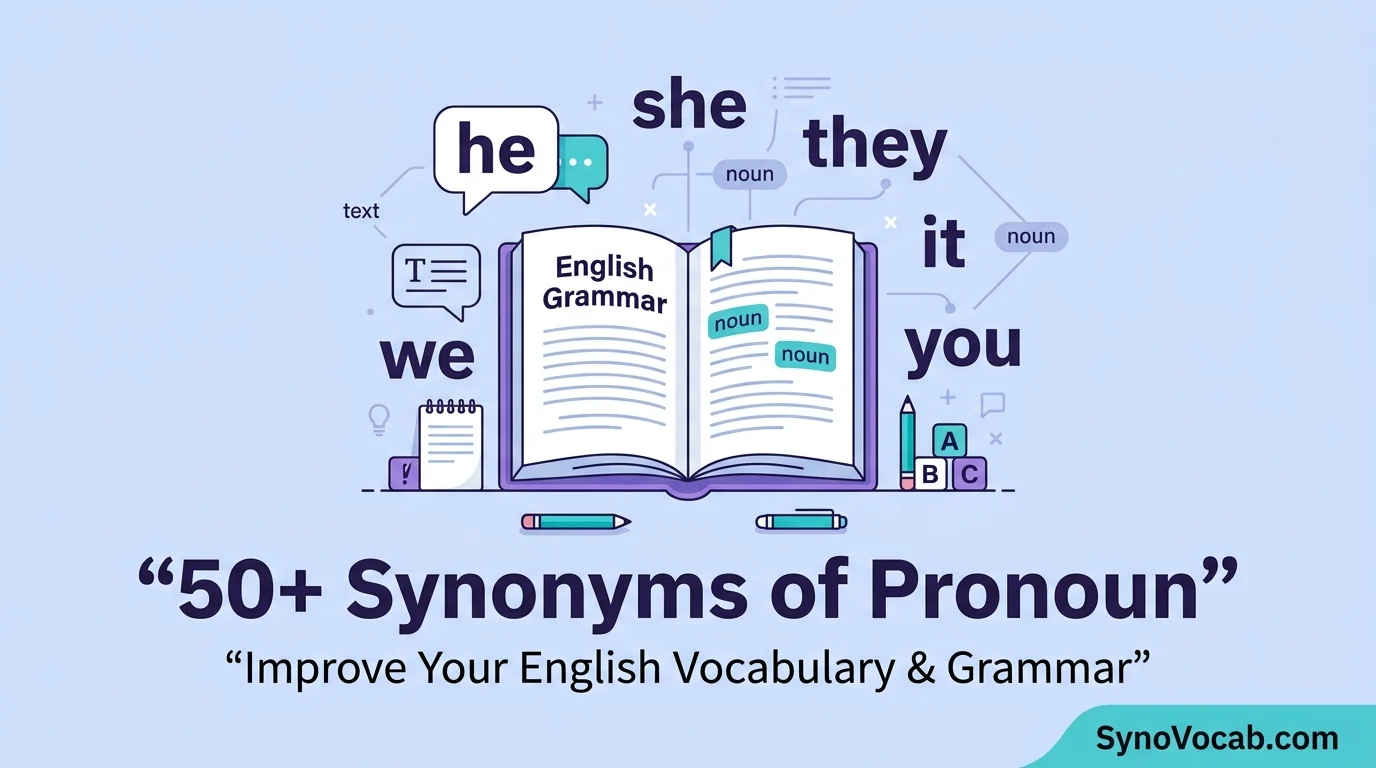
Have you ever used words like he, she, they, or it in a sentence? These words help us avoid repeating names again and again. They are called pronouns.
A pronoun is a word used instead of a noun. For example, instead of saying “Ali is happy. Ali is playing,” we say, “Ali is happy. He is playing.” Pronouns make sentences shorter and easier to read.
Learning synonyms of pronoun and related vocabulary is useful for students, bloggers, writers, and anyone learning English. These words improve grammar, writing, and communication skills. In this guide, you will learn synonyms of pronoun with simple meanings and easy examples.
⚡ Quick Answer
Synonyms of pronoun include substitute word, reference word, replacement noun, and identifier. These words relate to grammar words used instead of nouns.
1. Substitute Word
Meaning: A word replacing another word.
Examples:
- “He” is a substitute word.
- Pronouns replace names.
2. Reference Word
Meaning: A word pointing to someone or something.
Examples:
- “She” is a reference word.
- It refers to Sara.
3. Replacement Noun
Meaning: A word used instead of a noun.
Examples:
- Pronouns act as replacement nouns.
- “They” replaces names.
4. Identifier
Meaning: A word identifying someone.
Examples:
- “He” identifies Ali.
- Pronouns identify people.
5. Referring Word
Meaning: A word referring to something.
Examples:
- “It” is referring word.
- Pronouns point clearly.
6. Personal Pronoun
Meaning: Pronoun for a person.
Examples:
- “He” is personal pronoun.
- “They” is common.
7. Subject Pronoun
Meaning: Pronoun used as subject.
Examples:
- “She” runs fast.
- “They” are here.
8. Object Pronoun
Meaning: Pronoun receiving action.
Examples:
- I saw him today.
- She called them.
9. Possessive Pronoun
Meaning: Pronoun showing ownership.
Examples:
- The bag is mine.
- That car is theirs.
10. Reflexive Pronoun
Meaning: Pronoun referring back.
Examples:
- He hurt himself.
- She taught herself.
11. Demonstrative Pronoun
Meaning: Pronoun pointing something out.
Examples:
- This is beautiful.
- Those are expensive.
12. Relative Pronoun
Meaning: Pronoun connecting clauses.
Examples:
- The boy who smiled left.
- This is the book.
13. Interrogative Pronoun
Meaning: Pronoun asking questions.
Examples:
- Who called you?
- What happened today?
14. Indefinite Pronoun
Meaning: Pronoun for non-specific person.
Examples:
- Someone called me.
- Everyone enjoyed dinner.
15. Reciprocal Pronoun
Meaning: Pronoun showing shared action.
Examples:
- They helped each other.
- Friends respect one another.
16. Gender Pronoun
Meaning: Pronoun linked to gender.
Examples:
- “He” is gender pronoun.
- “She” is common.
17. Neutral Pronoun
Meaning: Pronoun without gender.
Examples:
- “They” is neutral pronoun.
- It sounds natural.
18. Singular Pronoun
Meaning: Pronoun for one person.
Examples:
- “He” is singular pronoun.
- “She” is singular too.
19. Plural Pronoun
Meaning: Pronoun for many people.
Examples:
- “They” is plural pronoun.
- “We” means many people.
20. Naming Substitute
Meaning: Word replacing names.
Examples:
- Pronouns are naming substitutes.
- They shorten sentences.
21. Word Substitute
Meaning: A replacement word.
Examples:
- Pronouns are word substitutes.
- They improve writing.
22. Placeholder Word
Meaning: Word taking another word’s place.
Examples:
- “It” is placeholder word.
- Pronouns save space.
23. Grammar Reference
Meaning: Word used in grammar reference.
Examples:
- Pronouns aid grammar reference.
- Students study them daily.
24. Noun Replacer
Meaning: Word replacing noun.
Examples:
- “They” is noun replacer.
- Pronouns reduce repetition.
25. Linguistic Substitute
Meaning: Grammar word replacing another.
Examples:
- Pronouns are linguistic substitutes.
- They simplify language.
26. Sentence Shortener
Meaning: Word making sentences shorter.
Examples:
- Pronouns shorten writing.
- They improve flow.
27. Connector Word
Meaning: Word connecting ideas smoothly.
Examples:
- Pronouns connect sentences.
- Writing feels smoother.
28. Speech Substitute
Meaning: Word replacing names in speech.
Examples:
- Pronouns help conversation.
- They sound natural.
29. Identity Word
Meaning: Word showing identity.
Examples:
- “He” shows identity.
- Pronouns describe people.
30. Label Word
Meaning: Word labeling someone.
Examples:
- Pronouns label subjects.
- Grammar uses them often.
31. Reference Term
Meaning: Word referring to someone.
Examples:
- Pronouns are reference terms.
- They point clearly.
32. Grammar Substitute
Meaning: Replacement word in grammar.
Examples:
- Pronouns are grammar substitutes.
- Students learn them early.
33. Mention Word
Meaning: Word mentioning someone indirectly.
Examples:
- “She” mentions Sara.
- Pronouns avoid repetition.
34. Subject Reference
Meaning: Pronoun referring to subject.
Examples:
- “He” is subject reference.
- “They” works too.
35. Language Placeholder
Meaning: Word standing in place.
Examples:
- Pronouns act as placeholders.
- Language becomes easier.
36. Human Reference
Meaning: Word referring to people.
Examples:
- “They” is human reference.
- Pronouns identify persons.
37. Conversational Shortcut
Meaning: Word simplifying speech.
Examples:
- Pronouns are shortcuts.
- They save time.
38. Sentence Helper
Meaning: Word improving sentence flow.
Examples:
- Pronouns help sentences.
- Writing sounds better.
39. Identity Substitute
Meaning: Replacement for names.
Examples:
- Pronouns replace names.
- They improve clarity.
40. Naming Word
Meaning: Word linked to naming.
Examples:
- Pronouns help naming.
- Grammar uses them often.
41. Language Tool
Meaning: Useful grammar word.
Examples:
- Pronouns are language tools.
- Students need them daily.
42. Speaking Aid
Meaning: Word helping conversation.
Examples:
- Pronouns aid speaking.
- They sound smoother.
43. Writing Aid
Meaning: Word improving writing.
Examples:
- Pronouns improve essays.
- They reduce repetition.
44. Grammar Marker
Meaning: Word showing grammar role.
Examples:
- Pronouns mark subjects.
- Grammar feels easier.
45. Naming Helper
Meaning: Word helping replace names.
Examples:
- Pronouns are naming helpers.
- Students use them daily.
46. Simplifier
Meaning: Something making language easier.
Examples:
- Pronouns simplify writing.
- Reading becomes smoother.
47. Functional Word
Meaning: Word serving grammar purpose.
Examples:
- Pronouns are functional words.
- Language needs structure.
48. Communication Tool
Meaning: Word improving communication.
Examples:
- Pronouns improve communication.
- They help clarity.
49. Descriptive Reference
Meaning: Word referring descriptively.
Examples:
- Pronouns guide readers.
- Writing becomes easier.
50. Expression Helper
Meaning: Word helping expression.
Examples:
- Pronouns improve expression.
- English sounds natural.
FAQs
1. What is a pronoun?
A pronoun is a word used instead of a noun.
2. What are examples of pronouns?
He, she, they, we, and it are pronouns.
3. Why are pronouns important?
They make sentences shorter and clearer.
4. What is the simplest synonym of pronoun?
“Replacement noun” is a simple synonym.
5. Why learn pronoun-related words?
They improve grammar, writing, and speaking skills.
Conclusion
Learning synonyms of pronoun helps you understand grammar and communication better. These words improve writing, speaking, and sentence structure.
Use these terms in essays, blogs, and daily conversations. Practice them often. Over time, your English vocabulary and grammar skills will become stronger and more natural.

I am Rana Fareed, an educator and content writer with an MPhil in Business Administration and an LLB (Law) degree. I write on current affairs, English language topics, and synonyms, simplifying complex ideas for everyday readers. Alongside teaching, I am passionate about helping people improve their knowledge and communication skills.