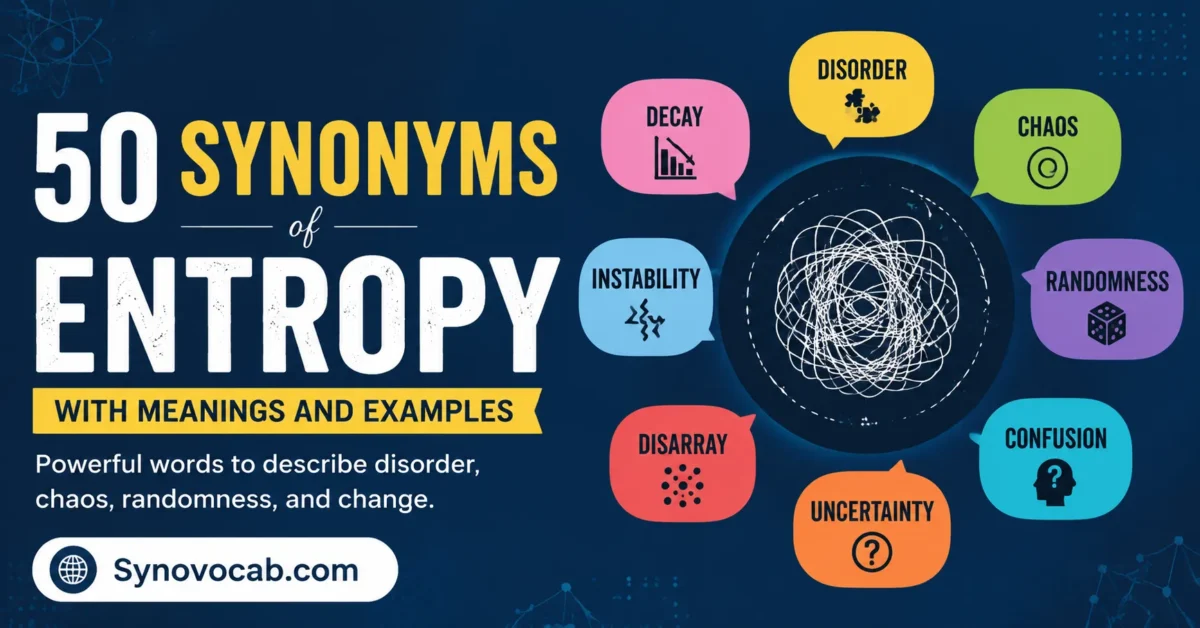
Quick answer: Synonyms of entropy include words like disorder, chaos, randomness, confusion, and decay.
Have you ever seen a messy room, a broken system, or a plan slowly lose its structure? These situations show the basic idea behind entropy: a movement from order toward disorder. In simple English, entropy means a state of increasing randomness, confusion, or lack of organization.
Learning the synonyms of entropy helps students understand complex ideas, bloggers create better content, writers avoid repetition, and daily English users choose more accurate words. For example, instead of saying “the situation became full of entropy,” you can say “the situation became chaotic” or “the system fell into disorder.”
Understanding the synonyms of entropy improves vocabulary and makes communication clearer. These words are useful in science, storytelling, business writing, and everyday conversations. Whether you are describing a messy environment, a failing process, or uncertainty about the future, the right synonym can make your message stronger.
Synonyms of Entropy
1. Disorder
Meaning: Lack of organization or proper arrangement.
Example: The files were in complete disorder after the computer crash.
2. Chaos
Meaning: A state of extreme confusion and lack of control.
Example: The unexpected storm created chaos in the city.
3. Randomness
Meaning: A condition where events happen without a clear pattern.
Example: The results appeared to be caused by randomness.
4. Confusion
Meaning: A state of being unclear or difficult to understand.
Example: The unclear instructions caused confusion among workers.
5. Disarray
Meaning: A messy or unorganized condition.
Example: The office was left in disarray after the move.
6. Uncertainty
Meaning: A lack of confidence or knowledge about something.
Example: Future uncertainty made investors cautious.
7. Instability
Meaning: A condition where something is likely to change or collapse.
Example: Political instability affected the economy.
8. Decline
Meaning: A gradual reduction in quality, strength, or order.
Example: The company experienced a decline after poor decisions.
9. Decay
Meaning: A process of gradual damage or deterioration.
Example: The old building showed signs of decay.
10. Breakdown
Meaning: A failure or loss of proper function.
Example: The machine suffered a complete breakdown.
11. Deterioration
Meaning: The process of becoming worse over time.
Example: The environment faced serious deterioration.
12. Collapse
Meaning: A sudden failure or falling apart of a structure or system.
Example: The bridge collapse shocked the entire community.
13. Confusion
Meaning: A lack of understanding or clear direction.
Example: The new rules created confusion for employees.
14. Mess
Meaning: A situation that is dirty, untidy, or disorganized.
Example: The children left a huge mess in the room.
15. Turmoil
Meaning: A state of great disturbance or disorder.
Example: The country went through political turmoil.
16. Upheaval
Meaning: A major change that creates disruption.
Example: The industry experienced a sudden upheaval.
17. Disturbance
Meaning: Something that interrupts peace or normal conditions.
Example: The noise caused a disturbance during the meeting.
18. Disruption
Meaning: An interruption that prevents normal activity.
Example: The internet disruption stopped online classes.
19. Anarchy
Meaning: A situation without rules, order, or authority.
Example: The region fell into anarchy after the government failed.
20. Confounding
Meaning: A condition that makes something difficult to understand.
Example: The confounding data required further research.
21. Irregularity
Meaning: A lack of normal pattern or consistency.
Example: Scientists noticed an irregularity in the results.
22. Unpredictability
Meaning: The quality of being impossible to predict accurately.
Example: Weather unpredictability makes travel planning difficult.
23. Variability
Meaning: The tendency to change or differ frequently.
Example: Data variability affected the final conclusion.
24. Volatility
Meaning: A tendency to change quickly and unpredictably.
Example: Market volatility worried many traders.
25. Entanglement
Meaning: A complicated or confused situation.
Example: The legal entanglement lasted for years.
26. Complication
Meaning: A problem that makes a situation harder.
Example: The project faced several unexpected complications.
27. Disorderliness
Meaning: A state of being untidy or poorly arranged.
Example: The disorderliness of the workspace reduced productivity.
28. Disorganization
Meaning: A lack of proper planning or structure.
Example: Poor disorganization caused delays in the project.
29. Fragmentation
Meaning: The process of breaking into smaller disconnected parts.
Example: The team suffered from fragmentation after the conflict.
30. Separation
Meaning: A state of being divided or disconnected.
Example: Social separation increased during the crisis.
31. Ruin
Meaning: A state of severe damage or destruction.
Example: The abandoned house fell into ruin.
32. Destruction
Meaning: The act of damaging something completely.
Example: The fire caused widespread destruction.
33. Wastage
Meaning: The unnecessary loss of resources or energy.
Example: Food wastage increased during the festival.
34. Dissolution
Meaning: The process of ending or breaking apart.
Example: The group faced dissolution after disagreements.
35. Erosion
Meaning: A gradual wearing away or weakening process.
Example: Trust erosion damaged their relationship.
36. Degradation
Meaning: A decline in quality or condition.
Example: Environmental degradation threatens wildlife.
37. Confoundedness
Meaning: A state of being confused or complicated.
Example: The theory created confoundedness among beginners.
38. Disorganization
Meaning: A condition where things lack structure or planning.
Example: The event failed because of disorganization.
39. Disorderliness
Meaning: A condition showing poor arrangement or control.
Example: The disorderliness of the records created problems.
40. Instability
Meaning: A lack of balance or reliability.
Example: Economic instability affected many families.
41. Fragmentation
Meaning: A state where something is divided into pieces.
Example: Media fragmentation changed how people receive news.
42. Confusion
Meaning: A situation where understanding is difficult.
Example: The announcement caused confusion among customers.
43. Chaos
Meaning: Complete lack of order or organization.
Example: The emergency created chaos everywhere.
44. Randomness
Meaning: A patternless or unpredictable condition.
Example: Randomness influenced the experiment results.
45. Decay
Meaning: A gradual process of becoming weaker or damaged.
Example: The wooden structure suffered from decay.
46. Decline
Meaning: A slow movement toward a lower condition.
Example: The population decline changed the region.
47. Breakdown
Meaning: A failure of a system or process.
Example: Communication breakdown caused delays.
48. Turbulence
Meaning: A period of confusion, conflict, or instability.
Example: The company faced financial turbulence.
49. Disorder
Meaning: A condition where things are not arranged correctly.
Example: The sudden change brought disorder to the system.
50. Randomness
Meaning: A lack of predictable order or pattern.
Example: The scientist studied randomness in natural events.
Related Searches
- synonyms of entropy in English
- words similar to entropy
- another word for entropy
- entropy meaning and synonyms
- opposite words of entropy
- scientific synonyms of entropy
- vocabulary words for disorder
- advanced English words for chaos
FAQ Section
What are the best synonyms of entropy?
The best synonyms of entropy are disorder, chaos, randomness, confusion, disarray, and uncertainty because they describe a movement away from order.
Is entropy the same as chaos?
Entropy and chaos are related but not exactly the same. Chaos describes confusion and lack of control, while entropy often refers to increasing randomness or loss of order.
Why should I learn synonyms of entropy?
Learning synonyms of entropy improves vocabulary, writing quality, and communication skills by helping you choose more precise words.
Can entropy synonyms be used in daily English?
Yes, many entropy synonyms such as disorder, confusion, chaos, and uncertainty are common in everyday conversations.
Are entropy synonyms useful for academic writing?
Yes, they help students and researchers explain complex ideas with clearer and more varied language.
Conclusion
Learning the synonyms of entropy helps improve writing, blogging, speaking, and everyday communication. Using different words for disorder, uncertainty, and change makes your language more interesting and precise.
These vocabulary choices can strengthen emails, essays, articles, and conversations. Practice using these words naturally, and you will develop a richer English vocabulary that helps you express ideas clearly in both professional and personal situations.

I am Rana Fareed, an educator and content writer with an MPhil in Business Administration and an LLB (Law) degree. I write on current affairs, English language topics, and synonyms, simplifying complex ideas for everyday readers. Alongside teaching, I am passionate about helping people improve their knowledge and communication skills.