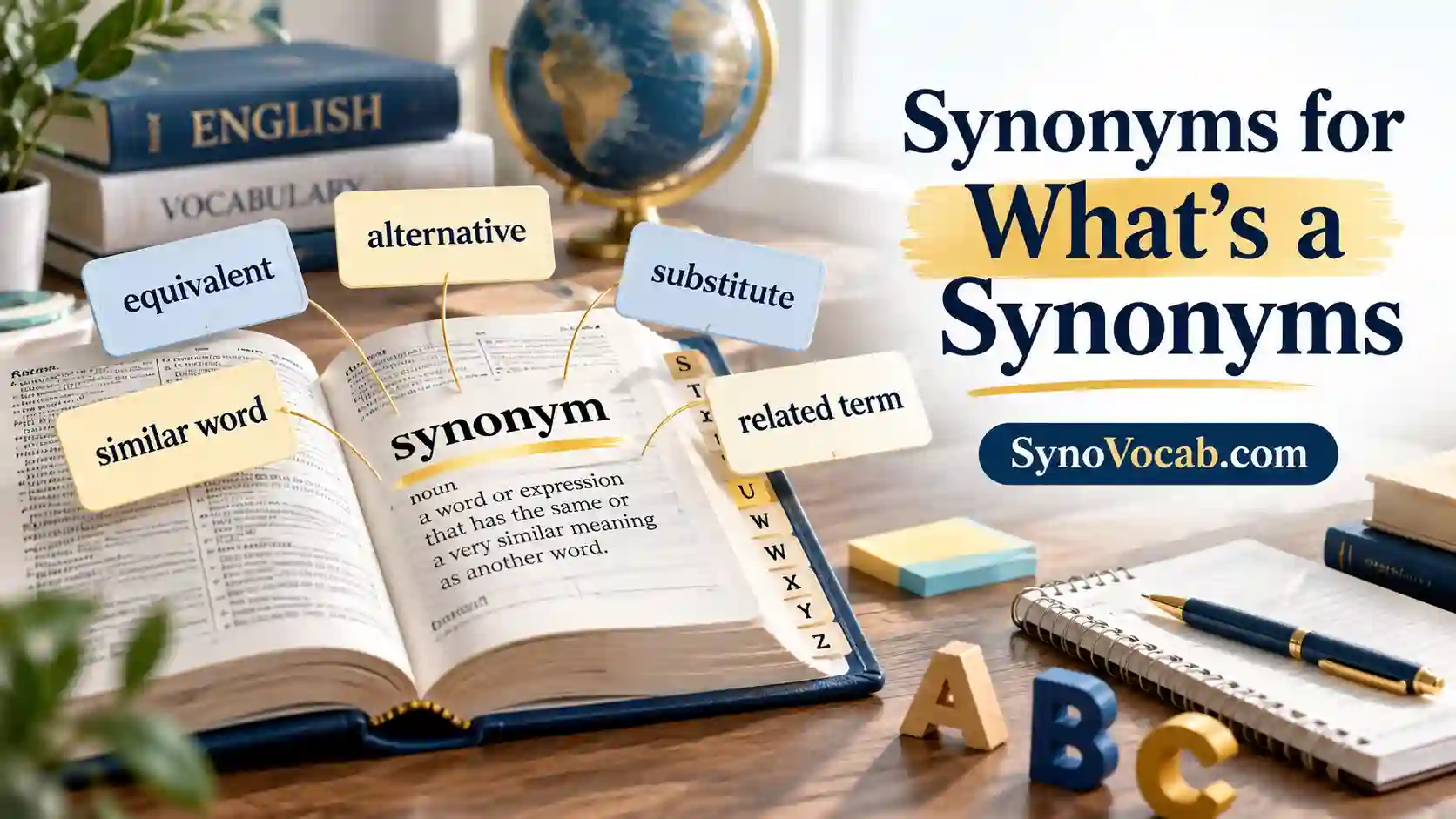
A synonym is a word that has the same or a similar meaning as another word, helping you express ideas in different ways.
Finding the right synonym can make your writing clearer, more interesting, and more natural. For example, instead of saying “happy” many times, you can use words like joyful, cheerful, or delighted.
The phrase “what’s a synonyms” is commonly searched by English learners who want to understand what synonyms are and how they work. Synonyms help improve vocabulary by showing different ways to communicate the same idea.
Students use synonyms to improve essays, writers use them to avoid repetition, bloggers use them to create engaging content, and English learners use them to speak more confidently in daily conversations.
What Does What’s a Synonyms Mean?
The correct phrase is “What’s a synonym?” A synonym is a word that has the same or nearly the same meaning as another word. Synonyms allow speakers and writers to choose better words depending on the situation.
For example, “big” and “large” are synonyms because both describe something with a great size. However, some synonyms may have slightly different feelings or levels of meaning.
Examples:
- The child is happy.
- The child is joyful.
- The child is cheerful.
All three sentences express a positive emotion, but each word creates a slightly different impression.
50+ Synonyms for What’s a Synonyms
Synonyms help you replace common words with more suitable alternatives. The best choice depends on the meaning, tone, and context of your sentence.
1. Equivalent
Meaning: A word or phrase that has the same or very similar meaning as another word.
Example: The teacher explained the equivalent meaning of the two words.
2. Similar Word
Meaning: A word that has a meaning close to another word.
Example: “Fast” and “quick” are similar words.
3. Alternative
Meaning: Another choice that can be used instead of something else.
Example: She found an alternative word for her essay.
4. Substitute
Meaning: A word used in place of another word.
Example: The writer used a substitute to avoid repetition.
5. Replacement
Meaning: Something that takes the place of another thing.
Example: This word is a good replacement for the original term.
6. Match
Meaning: Something that is equal or closely related in meaning.
Example: The two words are a close match in meaning.
7. Counterpart
Meaning: Something that has a similar role or meaning.
Example: The formal counterpart of this casual word is different.
8. Parallel
Meaning: Something that has a similar quality or meaning.
Example: The two expressions have parallel meanings.
9. Related Word
Meaning: A word connected to another word through meaning.
Example: “Beautiful” has many related words.
10. Similarity
Meaning: A quality of being almost the same.
Example: The similarity between these words is easy to notice.
11. Comparable
Meaning: Similar enough to be compared.
Example: These two words are comparable in meaning.
12. Alternative Expression
Meaning: A different way of saying the same idea.
Example: “Begin” is an alternative expression for “start.”
13. Different Term
Meaning: Another word used to describe the same concept.
Example: Scientists often use different terms for the same idea.
14. Related Term
Meaning: A word connected to a specific meaning or subject.
Example: This related term is common in academic writing.
15. Expression
Meaning: A word or phrase used to communicate an idea.
Example: This expression has a positive meaning.
16. Phrase
Meaning: A group of words with a particular meaning.
Example: The phrase has a similar meaning to the original sentence.
17. Word Choice
Meaning: The selection of a particular word for communication.
Example: Good word choice improves writing quality.
18. Vocabulary Option
Meaning: A possible word choice from your vocabulary.
Example: This vocabulary option sounds more professional.
19. Variant
Meaning: A different form of the same idea or word.
Example: This spelling variant is accepted in English.
20. Version
Meaning: A different form or way of expressing something.
Example: This version of the sentence sounds clearer.
21. Description
Meaning: Words used to explain something.
Example: The description gives the same meaning in another way.
22. Meaning
Meaning: The idea or concept represented by a word.
Example: The meaning of both words is almost identical.
23. Definition
Meaning: An explanation of what a word means.
Example: The dictionary provides a clear definition.
24. Explanation
Meaning: Information that makes an idea understandable.
Example: Her explanation helped students understand the word.
25. Interpretation
Meaning: A particular understanding of a word or phrase.
Example: Different readers may have different interpretations.
26. Description Word
Meaning: A word used to explain or describe something.
Example: Choose a description word that fits the situation.
27. Comparable Word
Meaning: A word with a similar meaning or purpose.
Example: “Smart” and “clever” are comparable words.
28. Close Meaning
Meaning: A meaning that is nearly the same.
Example: These words have a close meaning.
29. Near Equivalent
Meaning: A word that almost matches another word.
Example: This phrase is a near equivalent of the original.
30. Similar Expression
Meaning: A phrase that communicates a similar idea.
Example: She used a similar expression in her speech.
31. Matching Word
Meaning: A word that fits the same meaning or situation.
Example: Find a matching word for this sentence.
32. Common Alternative
Meaning: A frequently used replacement word.
Example: This is a common alternative used by native speakers.
33. Vocabulary Replacement
Meaning: A new word used instead of another word.
Example: Vocabulary replacement can improve your writing.
34. Language Choice
Meaning: A selected word or phrase in communication.
Example: Careful language choice makes writing stronger.
35. Word Variation
Meaning: A different form or choice of a word.
Example: Word variation prevents repeated phrases.
36. Linguistic Equivalent
Meaning: A word with the same meaning in language use.
Example: The translator found a linguistic equivalent.
37. Semantic Match
Meaning: Words that share a similar meaning.
Example: The two words are a semantic match.
38. Similar Concept
Meaning: An idea that is close in meaning.
Example: Both words represent a similar concept.
39. Connected Word
Meaning: A word linked by meaning.
Example: This connected word appears in many texts.
40. Related Expression
Meaning: A phrase connected to the same idea.
Example: The article includes related expressions.
41. Word Form
Meaning: A particular structure or version of a word.
Example: The word form changes depending on grammar.
42. Language Equivalent
Meaning: A word that carries the same meaning in another form.
Example: The dictionary shows the language equivalent.
43. Common Term
Meaning: A frequently used word for an idea.
Example: This common term is easy to understand.
44. Technical Equivalent
Meaning: A specialized word with the same meaning.
Example: The report uses a technical equivalent.
45. Descriptive Term
Meaning: A word used to describe something clearly.
Example: Choose a descriptive term for your article.
46. Word Pair
Meaning: Two words that have related meanings.
Example: “Begin” and “start” are a common word pair.
47. Meaningful Alternative
Meaning: A replacement word that keeps the original idea.
Example: This meaningful alternative sounds more natural.
48. Similar Vocabulary
Meaning: Words that share related meanings.
Example: Learning similar vocabulary improves fluency.
49. Related Vocabulary
Meaning: Words connected to a specific topic or idea.
Example: Students should learn related vocabulary.
50. Word Substitute
Meaning: A word that replaces another word.
Example: Use a word substitute to make your writing varied.
Context-Based Usage of Synonyms
Synonyms in Formal Writing
In formal writing, choose synonyms that sound professional and precise. Words like “assist” instead of “help” may create a more academic tone.
Synonyms in Daily Communication
Simple synonyms are often better for conversations. Common words help people understand your message quickly.
Synonyms in Creative Writing
Writers use synonyms to create emotion, improve descriptions, and avoid repeating the same words.
Comparison of Similar Terms
| Word | Meaning | Best Used For |
|---|---|---|
| Synonym | Similar meaning word | Vocabulary learning |
| Alternative | Another choice | Replacing words |
| Substitute | Something used instead | Practical replacement |
| Equivalent | Same meaning | Formal explanations |
| Related Word | Connected meaning | Vocabulary expansion |
Related Searches
- what is a synonym
- synonyms meaning and examples
- another word for synonym
- words similar to synonym
- synonym definition
- types of synonyms
- examples of synonyms
- synonym words list
FAQs
What is a synonym?
A synonym is a word that has the same or a similar meaning as another word.
Why are synonyms important?
Synonyms improve vocabulary, reduce repetition, and make communication more effective.
Are all synonyms exactly the same?
No. Many synonyms have similar meanings but may differ in tone or usage.
What is the difference between a synonym and an antonym?
A synonym has a similar meaning, while an antonym has the opposite meaning.
How can I learn more synonyms?
Reading books, practicing writing, and using dictionaries can help expand your synonym knowledge.
Conclusion
Learning synonyms is a simple way to improve your English vocabulary and communication skills. The right word can make your essays, emails, blog posts, and conversations clearer and more engaging.
Instead of repeating the same words, using suitable alternatives helps you express ideas with confidence and accuracy. Practice using new synonyms regularly to develop stronger writing and speaking skills.

I am Abubakar, an educator and content writer with a Master’s degree in English Language. I write about English language, vocabulary, and educational topics, simplifying complex concepts for everyday readers. Alongside my passion for teaching and learning, I focus on creating helpful and engaging content that improves knowledge, communication skills, and language understanding.