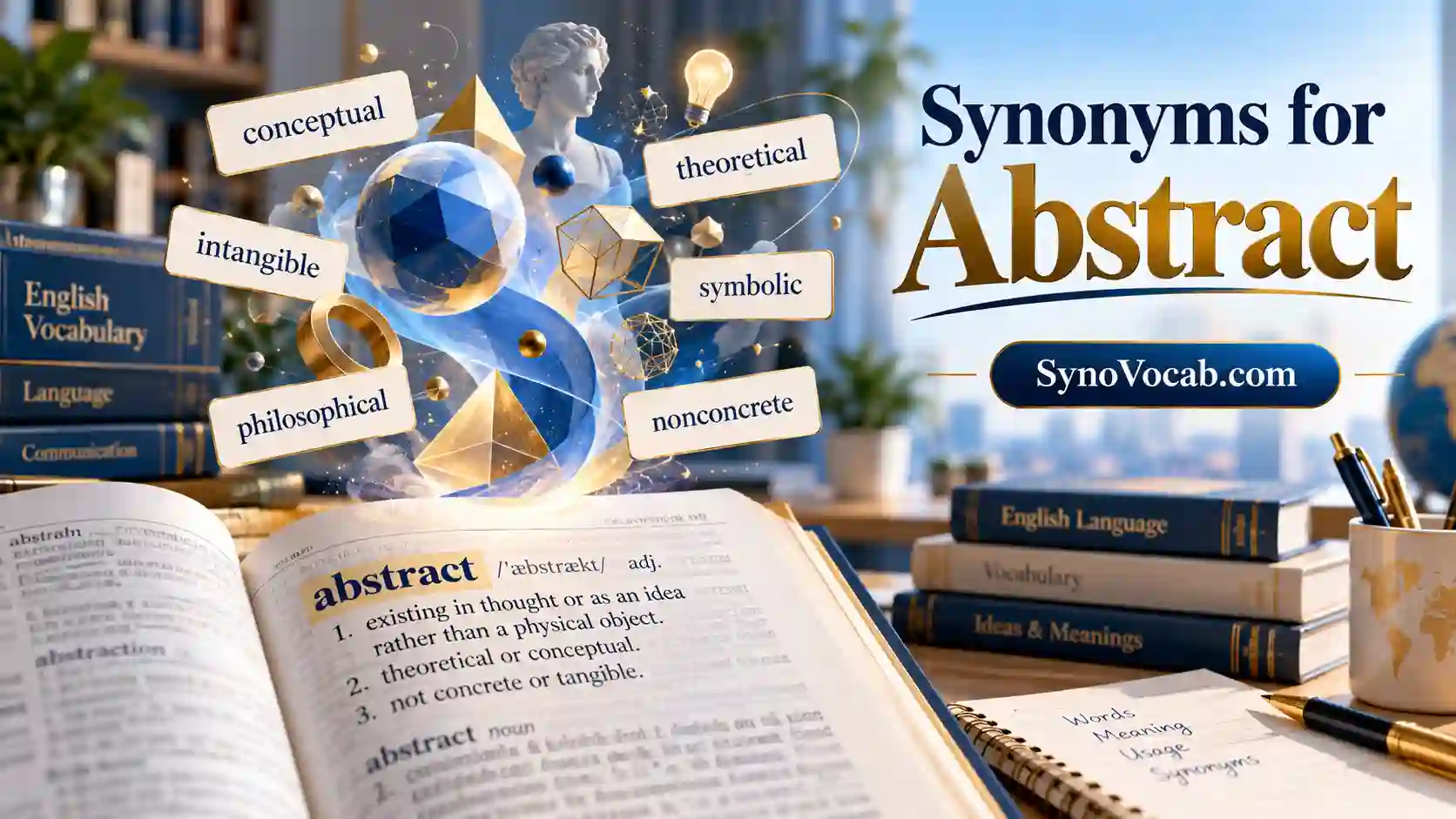
Quick answer: Some common synonyms for abstract include theoretical, conceptual, intangible, summary, brief, and hypothetical, depending on the context.
The word “abstract” appears in academic writing, art, discussions, and everyday communication. It can describe ideas that are difficult to see, understand, or connect with physical objects.
For example, “freedom” is an abstract idea because it cannot be touched, while “a book” is a concrete object that can be seen and held.
Learning synonyms for abstract helps students improve essays, writers create clearer content, bloggers choose accurate words, and English learners communicate with more confidence.
What Does Abstract Mean?
The word abstract has several meanings depending on how it is used. Generally, it describes something that exists as an idea rather than a physical object.
When discussing concepts, abstract refers to thoughts, theories, or qualities that cannot be directly experienced through the senses. In writing, an abstract can also mean a short summary of a longer document.
Examples:
- Love is an abstract emotion that means different things to different people.
- The researcher wrote an abstract of the scientific paper.
- The artist created an abstract painting with unusual shapes and colors.
Best Synonyms for Abstract
Different synonyms for abstract work in different situations. Some describe ideas, some describe summaries, and others explain things that are unclear or difficult to understand.
1. Conceptual
Meaning: Related to ideas, concepts, or theories rather than physical objects.
Example: The book explores conceptual ideas about human behavior.
2. Theoretical
Meaning: Based on ideas or principles rather than practical experience.
Example: The students discussed theoretical approaches to learning.
3. Intangible
Meaning: Unable to be touched or physically measured.
Example: Trust is an intangible quality in relationships.
4. Immaterial
Meaning: Not physical or not consisting of material things.
Example: Happiness is an immaterial part of a meaningful life.
5. Idealistic
Meaning: Based on ideals rather than practical realities.
Example: His idealistic vision focused on creating a better society.
6. Philosophical
Meaning: Connected with deep ideas about life and existence.
Example: She asked philosophical questions about human nature.
7. Hypothetical
Meaning: Based on a possible situation rather than a real one.
Example: The teacher presented a hypothetical example.
8. Imaginary
Meaning: Existing only in the mind or imagination.
Example: Children often create imaginary worlds during play.
9. Unreal
Meaning: Not existing in physical reality.
Example: The story describes an unreal fantasy world.
10. Abstracted
Meaning: Removed from practical or physical details.
Example: The theory was abstracted from real-life examples.
11. Summary
Meaning: A shortened version containing the main points.
Example: She prepared a summary of the article.
12. Brief
Meaning: Short and containing only important information.
Example: He gave a brief explanation of the topic.
13. Outline
Meaning: A general description of the main ideas.
Example: The outline explained the structure of the report.
14. Synopsis
Meaning: A short overview of a longer work.
Example: The publisher requested a synopsis of the novel.
15. Digest
Meaning: A shortened version of important information.
Example: The magazine published a digest of recent research.
16. Condensed
Meaning: Reduced in length while keeping key information.
Example: The article provides a condensed explanation of the study.
17. Generalized
Meaning: Described broadly without specific details.
Example: The statement was too generalized to explain the issue.
18. Broad
Meaning: Covering general ideas instead of details.
Example: The discussion remained broad and theoretical.
19. Vague
Meaning: Not clearly explained or defined.
Example: His answer was vague and needed more details.
20. Unclear
Meaning: Difficult to understand or interpret.
Example: The instructions were unclear to new users.
21. Ambiguous
Meaning: Having more than one possible meaning.
Example: The sentence was ambiguous and confused readers.
22. Obscure
Meaning: Difficult to understand or not well known.
Example: The writer used an obscure reference.
23. Complex
Meaning: Made of many connected ideas or parts.
Example: The scientist explained a complex theory.
24. Abstracted
Meaning: Separated from specific examples or reality.
Example: The artist abstracted natural shapes into simple forms.
25. Nonphysical
Meaning: Not existing as a physical object.
Example: Emotions are nonphysical experiences.
26. Spiritual
Meaning: Related to beliefs, inner experiences, or the soul.
Example: The poem explores spiritual themes.
27. Invisible
Meaning: Unable to be seen.
Example: Some invisible forces affect our daily lives.
28. Figurative
Meaning: Expressing ideas through symbols or comparisons.
Example: The author used figurative language in the poem.
29. Symbolic
Meaning: Representing a deeper meaning.
Example: The dove is a symbolic image of peace.
30. Metaphorical
Meaning: Expressed through comparison rather than literal meaning.
Example: The phrase has a metaphorical meaning.
31. Notional
Meaning: Existing as an idea or concept.
Example: The plan was based on a notional framework.
32. Intellectual
Meaning: Connected with thinking, reasoning, or knowledge.
Example: The debate involved intellectual questions.
33. Cognitive
Meaning: Related to thinking and understanding.
Example: The research examines cognitive processes.
34. Mental
Meaning: Related to the mind rather than physical objects.
Example: Memory is a mental ability.
35. Rational
Meaning: Based on ideas, logic, or reasoning.
Example: The argument followed a rational approach.
36. Speculative
Meaning: Based on guesses or possibilities.
Example: The article contains speculative ideas about the future.
37. Imagined
Meaning: Created by the mind.
Example: The story describes an imagined place.
38. Creative
Meaning: Based on original ideas or imagination.
Example: The designer developed a creative concept.
39. Innovative
Meaning: Introducing new ideas or methods.
Example: The company created an innovative solution.
40. Abstracted Summary
Meaning: A shortened version that removes unnecessary details.
Example: The report included an abstracted summary.
41. Thematic
Meaning: Related to a central idea or theme.
Example: The novel has a strong thematic structure.
42. Ideational
Meaning: Related to ideas or thoughts.
Example: The discussion focused on ideational changes.
43. Conceptualized
Meaning: Formed as an idea or concept.
Example: The project was conceptualized last year.
44. Symbolic
Meaning: Representing something beyond its literal form.
Example: The image carries symbolic meaning.
45. Ideal
Meaning: Existing as a perfect idea or standard.
Example: They searched for an ideal solution.
46. Imageless
Meaning: Without a clear physical picture or form.
Example: The idea remained imageless and difficult to describe.
47. Abstracted Thought
Meaning: A thought separated from concrete examples.
Example: Philosophy often involves abstracted thought.
48. Nonconcrete
Meaning: Not based on physical reality.
Example: Justice is a nonconcrete concept.
49. Invisible Concept
Meaning: An idea that cannot be physically observed.
Example: Time is an invisible concept.
50. Pure
Meaning: Existing as an idea without practical details.
Example: The theory remained a pure concept.
Context-Based Usage of Abstract Synonyms
Synonyms for Abstract When Talking About Ideas
Words like conceptual, theoretical, philosophical, and intellectual are useful when discussing thoughts, theories, and knowledge.
Example: “The researcher presented a theoretical explanation of the problem.”
Synonyms for Abstract in Formal Writing
Academic writing often uses words such as conceptual, theoretical, generalized, and analytical because they sound precise and professional.
Example: “The study provides a conceptual framework for future research.”
Synonyms for Abstract Meaning Summary
When abstract means a short version of information, use words like summary, synopsis, outline, brief, and digest.
Example: “The abstract gives readers a quick overview of the research.”
Abstract vs Similar Words
| Word | Meaning | Best Used For |
|---|---|---|
| Abstract | Based on ideas rather than physical things | Concepts, art, research |
| Conceptual | Related to concepts and ideas | Theories and planning |
| Theoretical | Based on principles or assumptions | Academic discussions |
| Summary | Short version of information | Reports and articles |
| Symbolic | Representing deeper meanings | Art and literature |
Related Searches
- another word for abstract
- abstract meaning and examples
- words similar to abstract
- synonyms for abstract ideas
- abstract words list
- abstract meaning in English
- alternatives for abstract
- conceptual synonyms
FAQs
What is the best synonym for abstract?
The best synonym depends on context. “Conceptual” works for ideas, while “summary” works when referring to a short overview.
Is abstract a positive or negative word?
Abstract is neutral. It can describe creative ideas, complex theories, or information summaries.
What is the opposite of abstract?
The opposite of abstract is usually “concrete,” meaning something physical, specific, or easily observed.
Can abstract and conceptual be used interchangeably?
Sometimes, but conceptual focuses more on ideas, while abstract can also mean unclear, theoretical, or summarized.
What are abstract words in English?
Abstract words describe ideas, emotions, and qualities that cannot be physically touched, such as love, freedom, and honesty.
Conclusion
Learning synonyms for abstract helps improve vocabulary, writing style, and communication skills.
The right alternative can make an essay clearer, a blog post more engaging, or a conversation more precise.
Use these words in essays, emails, articles, and everyday discussions to express ideas with greater accuracy.

I am Abubakar, an educator and content writer with a Master’s degree in English Language. I write about English language, vocabulary, and educational topics, simplifying complex concepts for everyday readers. Alongside my passion for teaching and learning, I focus on creating helpful and engaging content that improves knowledge, communication skills, and language understanding.