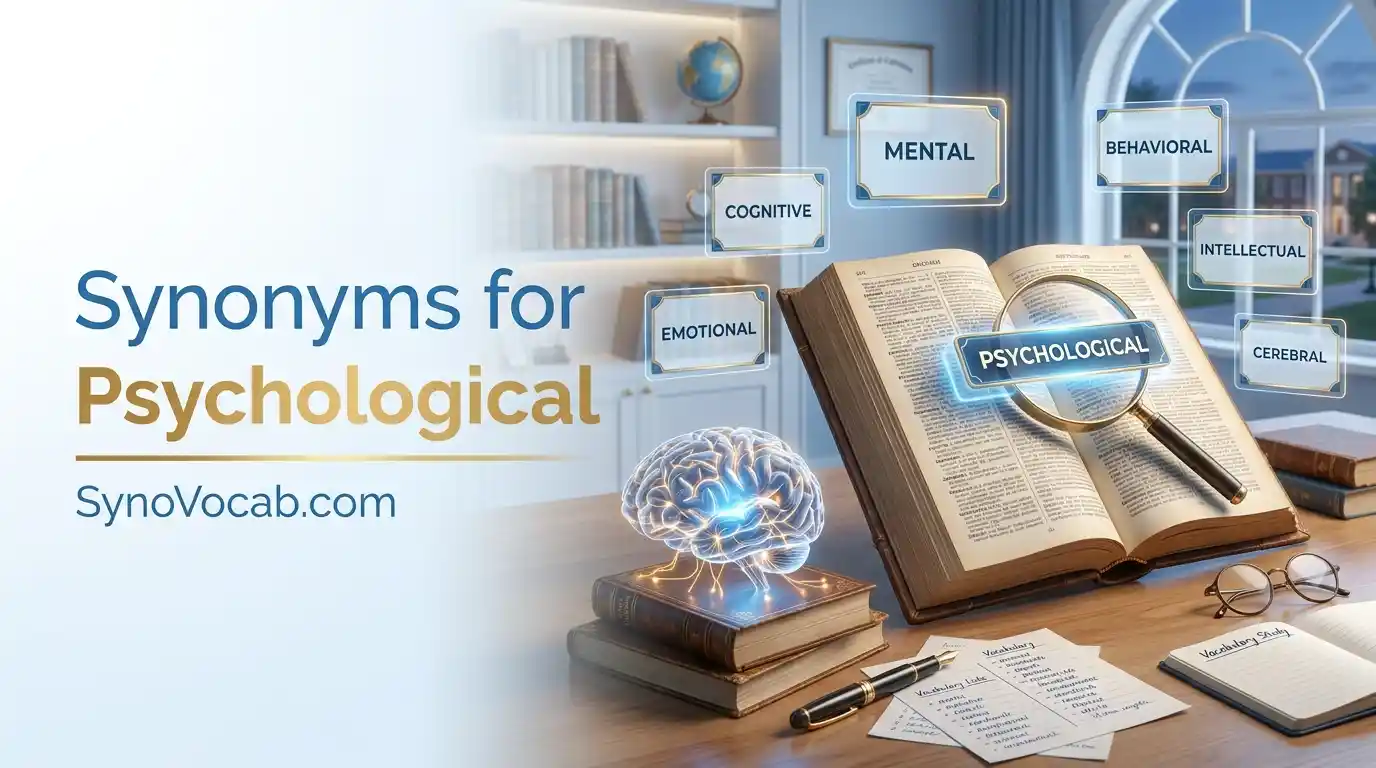
Quick answer: The best synonyms for psychological include mental, emotional, cognitive, behavioral, intellectual, and inner, depending on the context.
The word “psychological” appears often in conversations about the mind, emotions, behavior, and human experiences. Choosing the right alternative can make writing clearer, more accurate, and more engaging.
For example, a writer may say “psychological effects of stress” or choose “mental effects of stress” for a simpler expression. The best word depends on whether the focus is emotions, thinking, behavior, or the human mind.
Learning synonyms for psychological helps students write better essays, writers create stronger descriptions, bloggers improve content quality, and English learners expand vocabulary.
What Does Psychological Mean?
Psychological means relating to the mind, thoughts, emotions, feelings, or behaviour of a person. It is commonly used when discussing mental processes, human reactions, and emotional experiences.
Examples:
- Stress can have psychological effects on a person’s health.
- The study explores psychological development in children.
- Music can create a psychological connection with listeners.
Best Synonyms for Psychological
Different alternatives for psychological highlight different meanings. Some focus on thoughts, while others describe emotions, behavior, or mental processes. Choosing the right synonym depends on the situation.
1. Mental
Meaning: Related to the mind or thinking process.
Example: Meditation can improve mental health.
2. Emotional
Meaning: Connected with feelings and emotions.
Example: The movie had a strong emotional impact.
3. Cognitive
Meaning: Related to thinking, learning, and understanding.
Example: The research examined cognitive abilities in students.
4. Behavioral
Meaning: Connected with actions and habits.
Example: The therapist studied behavioral changes.
5. Intellectual
Meaning: Related to reasoning and knowledge.
Example: The book offers intellectual challenges.
6. Inner
Meaning: Connected with private thoughts or feelings.
Example: She experienced inner conflict.
7. Mindful
Meaning: Related to awareness and attention.
Example: Mindful practices can reduce anxiety.
8. Subjective
Meaning: Based on personal thoughts or feelings.
Example: Pain can have a subjective experience.
9. Perceptual
Meaning: Related to how people understand and interpret information.
Example: The study focused on perceptual differences.
10. Mentalistic
Meaning: Related to explanations involving the mind.
Example: The theory uses a mentalistic approach.
11. Brain-related
Meaning: Connected with the brain and its functions.
Example: Researchers studied brain-related disorders.
12. Neurological
Meaning: Related to the nervous system and brain activity.
Example: The patient received neurological testing.
13. Psychological-based
Meaning: Founded on ideas about the mind and behavior.
Example: The program uses psychological-based methods.
14. Affective
Meaning: Related to emotions and moods.
Example: The study measured affective responses.
15. Sentimental
Meaning: Connected with strong personal feelings.
Example: The letter had sentimental value.
16. Reflective
Meaning: Related to careful thought and self-examination.
Example: She wrote a reflective essay.
17. Thoughtful
Meaning: Showing careful thinking or consideration.
Example: He gave a thoughtful response.
18. Rational
Meaning: Related to logical thinking and reasoning.
Example: The decision required rational thinking.
19. Analytical
Meaning: Related to examining ideas carefully.
Example: The researcher used an analytical method.
20. Behavioral-science
Meaning: Related to the scientific study of behavior.
Example: The report covers behavioral-science research.
21. Emotionalistic
Meaning: Strongly connected with emotional reactions.
Example: The speech used an emotionalistic style.
22. Conscious
Meaning: Related to awareness and thought.
Example: She made a conscious effort to improve.
23. Subconscious
Meaning: Related to thoughts or feelings below awareness.
Example: Dreams may reflect subconscious fears.
24. Unconscious
Meaning: Related to mental processes outside awareness.
Example: The habit was influenced by unconscious patterns.
25. Experiential
Meaning: Related to personal experiences and feelings.
Example: The therapy included experiential activities.
26. Human
Meaning: Related to people and their experiences.
Example: The article explores human emotions.
27. Personal
Meaning: Related to an individual’s feelings or experiences.
Example: She shared her personal struggles.
28. Individual
Meaning: Connected with a specific person.
Example: Everyone has individual responses to stress.
29. Internal
Meaning: Existing within the mind or self.
Example: He faced internal pressure.
30. Private
Meaning: Related to personal thoughts or feelings.
Example: She kept her private emotions hidden.
31. Emotional-health
Meaning: Connected with emotional well-being.
Example: Exercise supports emotional health.
32. Mental-health
Meaning: Related to a person’s psychological well-being.
Example: Schools provide mental-health support.
33. Behavioral-pattern
Meaning: Related to repeated ways of acting.
Example: The study identified behavioral patterns.
34. Developmental
Meaning: Related to growth and change over time.
Example: The psychologist studied developmental stages.
35. Social
Meaning: Connected with interactions and relationships.
Example: Social factors influence behavior.
36. Interpersonal
Meaning: Related to relationships between people.
Example: Interpersonal skills improve communication.
37. Motivational
Meaning: Related to reasons behind actions.
Example: The coach studied motivational factors.
38. Behavioral-related
Meaning: Connected with actions and responses.
Example: The research explored behavioral-related issues.
39. Emotional-minded
Meaning: Focused on feelings and emotional responses.
Example: The character showed an emotional-minded approach.
40. Reasoning-based
Meaning: Related to thought and logical processes.
Example: The decision followed a reasoning-based method.
41. Cognitive-based
Meaning: Connected with thinking and learning processes.
Example: The course uses cognitive-based techniques.
42. Mind-related
Meaning: Connected with thoughts, feelings, or awareness.
Example: The book discusses mind-related topics.
43. Brain-centered
Meaning: Focused on brain functions and activity.
Example: The research takes a brain-centered view.
44. Emotional-focused
Meaning: Concentrating on feelings and emotional states.
Example: The therapy uses an emotional-focused approach.
45. Thought-related
Meaning: Connected with ideas and thinking.
Example: The article examines thought-related processes.
46. Perceptive
Meaning: Related to understanding and noticing things clearly.
Example: She gave a perceptive analysis.
47. Insightful
Meaning: Showing deep understanding of thoughts or behavior.
Example: The psychologist shared an insightful observation.
48. Introspective
Meaning: Focused on examining one’s own thoughts.
Example: His writing was deeply introspective.
49. Meditative
Meaning: Related to calm reflection and awareness.
Example: Meditation creates a meditative state.
50. Psychological-minded
Meaning: Able to understand thoughts, emotions, and behavior.
Example: She has a psychological-minded approach to counseling.
Context-Based Usage of Psychological Synonyms
Synonyms for Psychological When Talking About Emotions
When discussing feelings, emotional, affective, sentimental, and inner are often better choices because they highlight human experiences and reactions.
Example: “The event caused psychological stress” can become “The event caused emotional stress.”
Synonyms for Psychological in Formal Writing
Academic writing often uses cognitive, behavioral, neurological, and developmental because these words sound more specific and scientific.
Example: “Psychological research” may become “cognitive research” when discussing thinking processes.
Synonyms for Psychological When Describing the Mind
Words such as mental, internal, subconscious, and introspective work well when focusing on thoughts and awareness.
| Word | Meaning | Best Used For |
|---|---|---|
| Mental | Related to the mind | General writing |
| Emotional | Related to feelings | Personal experiences |
| Cognitive | Related to thinking | Academic topics |
| Behavioral | Related to actions | Psychology studies |
| Neurological | Related to the brain | Medical contexts |
Related Searches
- another word for psychological
- psychological meaning and examples
- words similar to psychological
- alternatives for psychological
- different ways to say psychological
- psychological synonyms for essays
- formal synonyms for psychological
- psychological related words
FAQ Section
What is the simplest synonym for psychological?
The simplest synonym for psychological is “mental” because it directly relates to the mind.
Can emotional replace psychological?
Sometimes. Emotional works when discussing feelings, but psychological has a broader meaning involving thoughts and behavior.
What is a formal synonym for psychological?
Cognitive, behavioral, and neurological are common formal alternatives depending on the topic.
Is mental the same as psychological?
Mental and psychological are similar, but psychological can include emotions, behavior, and mental processes.
Which synonym is best for academic writing?
Cognitive, behavioral, and neurological are often suitable for academic and scientific writing.
Conclusion
Learning synonyms for psychological helps improve vocabulary, writing style, and communication skills.
The right word can make an essay clearer, a blog post more engaging, and a conversation more precise.
Use these alternatives carefully in essays, emails, articles, and everyday discussions. A strong vocabulary is not only about knowing more words but also about choosing the word that expresses the exact meaning you want.

I am Abubakar, an educator and content writer with a Master’s degree in English Language. I write about English language, vocabulary, and educational topics, simplifying complex concepts for everyday readers. Alongside my passion for teaching and learning, I focus on creating helpful and engaging content that improves knowledge, communication skills, and language understanding.